Posts

Showing posts with the label Beckett Samuel

A Spring Diary

Image
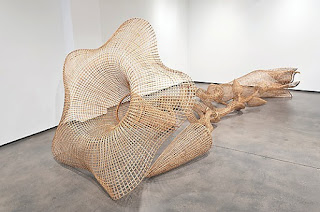
Morning Glory , Sopheap Pich, 2011 April 21, had lunch with David Curzon. Before lunch, he showed me his Asian art collection in his UWS apartment. Japanese paintings, Chinese bronzes and ceramics, and Indian sculptures. He gave me his book of 100 midrashim The View from Jacob's Ladder . The commentary on Biblical texts is creative and witty; it often applies another text, literary or religious, to interpret the Bible. The titular commentary is a tour-de-force. It thinks about Jacob's ladder in terms of emotional states, existence, mercy, effects, assent, the heart, success, love, clean hands, sojourn, connection, a difficult equilibrium, invitation, and, finally, enchantment. The writing records the return of a secular Jew to the tradition of his forefathers. His family escaped from the Holocaust to Australia. He found his way as an adult to New York, a Jewish city, as he called it. April 27, watched Becket's Fragments  with GH at the Baryshnikov Arts Center. Direct...

A Pack of Nobodies

Image
I watched my last two White Light Festival events this week. On Wednesday LW and I watched "I went to the house but did not enter," a staged concert in three tableaux, at the Rose Theater. Conceived by German composer Heiner Goebbels, the production staged three modernist texts, T.S. Eliot's "The Love Song of J. Alfred Prufrock," Maurice Blanchot's "The Madness of the Day," and Samuel Beckett's "Worstward Ho," with Kafka's short story "Excursion into the Mountains" functioning as an interlude between Blanchot and Beckett. The Hillard ensemble, a British early and modern music group, sang. Of the three tableaux, I found Blanchot most interesting. The fragmentation of self into "a pack of nobodies" (Kafka's phrase) was given dramatic and visual force by the isolation of the men in separate rooms of an ordinary-looking house. The gurgle of a washing machine, the siren of a passing ambulance, the clang of a...

Roundabout Theatre's "Waiting for Godot"

Thursday night: it was a funny experience watching a play I had heard and read so much about without ever having watched or read it. I felt all the time that I had seen it before but that the present performance was different from what I thought I knew. For one thing, this Godot had four characters (and a boy who brought word that Godot was not coming that day) when I thought there were supposed to be two. For another, it was much funnier than I had expected. Nathan Lane played an articulate and despairing Estragon, Bill Irwin played an irascible Vladimir, John Goodman played a hapless Pozzo, and John Glover played a pathetic and ferocious Lucky. They were terrific clowns, entertaining the audience as much as they entertained themselves, to occupy the time while waiting for Godot.  Tied to Pozzo literally by a string, Lucky was cuffed around like a slave, but would kill anyone who tried to free him. It was better to belong to someone than to no one. A funny and sad moment came ...

TLS February 29 2008

from Marina Warner's Commentary "Who can shave an egg" on Beckett and Mallarme: The foreign word takes us to a different level, where its embodied character, its sound and shape, act more directly on our physical receptors because they are freed from intelligibility. The physicality of a word grows lighter and less substantial when we know what it means without having to think. How to avoid this attenuation, with its corresponding drying up of the aesthetic response, becomes the writer's task. Jee: This line of thinking is alluring, but wrong, I think. A word does not become attenuated when it is intelligible. The problem does not lie in intelligibility, but in the quality of the attention brought to bear on the word. There is an instrumental attention, what we do to survive the day-to-day, and there is an aesthetic attention, which we bring to a work of art. In her first essay in Proof and Theories , Gluck explains she uses simple diction in her poetry, such as t...