Posts

Showing posts with the label Photography

Cyborg Sex

Last Tuesday, went to the Morgan Library to see the show of Peter Hujar's photographs: "Speed of Life." The creator of the iconic image of the Gay Liberation Front, showing 2 lines of young people walking down the street, arms linked, fists punching the air, Hujar was really a portraitist. The most compelling photos are headshots, followed by those of the body in half-recline. Since I was there, I also looked into the Tennessee Williams show, "No Refuge but in Writing." The final plays are really the results of lots of earlier stories, aborted versions, and messy revisions, suggested by Eliza Kazan and others, as much as by Williams's own muse. He exploited his life for his materials, as all writers do, and his life included other people's lives. * Wrote "Returning from the Women's March in DC" on Friday, tinkled with "Judy" on Saturday, and "Cyborg Vs The Grim Reaper" this morning. Cyborg sex: the wave of the futu...
Haiku

Image
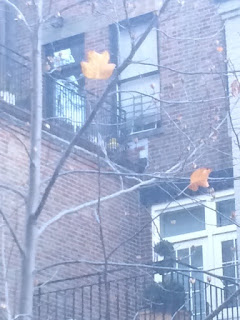
Two last leaves we were awake and then we drifted off

Tate Britain and Haiku

Saw the special Barbara Hepworth retrospective at Tate Britain yesterday. The exhibit showed her moving from early figurative works into abstract forms. The early abstractions explored single and double standing forms: self and relations. Both became interiorized, it seemed to me, in later abstractions that explored the relationship between her inner and outer worlds, in her response to the seascape of St. Ives, for instance. The later sculptures, often round in shape, were punctured or gorged with holes, as if to allow light (and eyes) in. At the same time, these holes functioned as framing devices, through which one could see the other side. One of the most powerful sculptures had a punctured ball sitting inside the puncture of another ball. It was also a fine example of her move late in her career into bronze, after working mostly with wood and marble. Really enjoyed the show "New Brutalist Image 1949 - 1955: Hunstanton School and the Photography of Life and Art." The s...

Facing the Light

Image
Andrew's book of photographs and drawings of Arnold arrived last week. It's a beautiful book, a moving record not only of Arnold's life, but also of the collaboration between artist and model. From the back cover: Arnold Ziza, a model from Manchester, came to the United Kingdown as a refugee from the Democratic Republic of the Congo. That transition changed his life and his sense of self. This book is a biography in images, a record of his outer and inner changes from late boyhood to early manhood.  Produced with both imagination and passion, it's a gift that I cherish.

Poem: "On My Way to a Photo Exhibition of Trees in New York City"

Image
Photo by Benjamin Swett; cover image for his book New York City of Trees On My Way to a Photo Exhibition of Trees in New York City I’m walking into the wind. Now I know what the sail feels, the tiller in another’s hand. Now I know the sad flapping of clothes pegged to a short line. The street sign quavers on its metal stem like a cymbal struck. It is not a human sound, and the black coats, feet scratching the sidewalk, will strain in their drift toward a human sound, but, as Dante observed, before he heard the love that Francesca da Rimini bore for her husband’s handsome young brother, the lights are mute here. 

An Unlikely Pair

Image
Watched Beautiful Boxer (2004) with GH Friday night. Based on the true life story of Parinya Charoenphol, a Muay Thai boxer who underwent a sex change to become a woman, the movie was a sweet and sensitive call to be true to oneself. In the case of Nong Toom (Asanee Suwan), the call does not only mean to become the woman that she has always felt herself to be, but it also means not to allow oneself to be commodified in the arena of Thai kickboxing. There was a touching last scene in which Nong Toom, transformed into beautiful Parinya Charoenphol, watched a little boy fighter imitating her make-up and gestures. He looked so miserable that it was obvious to her that his father had put him up to it, so as to attract publicity. She wiped off his lipstick and told him to be himself. Another moving scene took place when Parinya saw in the mirror Nong Toom bidding her farewell. She bade her past person farewell somewhat sadly. We may be happy to get what we want, but that does not m...

Rineka Dijkstra's Mid-Career Retrospective at the Guggenheim

I have seen and liked Rineke Dijkstra's beach portaits of adolescents around the world, and so went to see her mid-career retrospective at the Guggenheim last Wednesday. The beach portraits (1992 - 2002) were as mesmerizing as ever, as were the group portraits of teenagers in parks in Amsterdam, Berlin and Barcelona. In the hands of a lesser photographer, the portraits could have been mistaken for advertisements for United Colors of Benetton, but the teenagers were seen so sympathetically and individually that there was no mistaking the artistic eye. The young people were wearing branded clothes, but they were shown to be so much more than their brands. The Amerisa series, begun in 1994 and on-going, followed a young Bosnian girl who sought Dutch asylum through her gradual integration into mainstream Dutch culture. The last photograph shown was of Amerisa carrying her baby. I was also fascinated by Dijkstra's Olivier series (2000 - 03). It traced the physical and psychologi...

"Revolution! The Atlantic World Reborn"

Last Sunday GH and I went to the New York Historical Society to look at a few of its current exhibitions. "Harlem," a show of photographs by Camilo José Vergara, was only of passing interest.  "Hudson River School Highlights" was a small show of Romantic landscapes mainly by Asher B. Durand. We also saw "Urban Views: American Cities 1717-1986." That show concluded with a photo-montage of Canal Street, New York City, by architect and photographer Claude Samton. GH who lived in the neighborhood in the 1980's was very happy to see restored his memories of various stores selling art supplies, metal scrap and rubber tires. After he left, I took in the wonderful show "Revolution! The Atlantic World Reborn." From the Society's website: Revolution! The Atlantic World Reborn is the first exhibition to relate the American, French and Haitian revolutions as a single, global narrative. Spanning decades of enormous political and cultural changes...

Susan Howe's "That This"

That This , about the death of Howe's husband, the philosopher Peter Hare, is an odd and sometimes beautiful book. The three parts that make up the book are very different, one might even say, at odds. Or so they seem. The first part titled "The Disappearance Approach" is a rather conventional arrangement of diary-like prose entries. Beginning with the discovery of Hare dead in his bed, it proceeds by weaving fragments of memories with reflections on Jonathan Edwards and his family, Milton, W.H. Auden, Nicolas Poussin, and Ovid. The literary and artistic references give a sense of the couple's shared life, the Edwards reinforcing the New England connection, but they are also a rather familiar device to raise the tone and deepen the significance of one's loss. Nothing particularly memorable is said about the writers. After quoting from a letter by Sara Edwards telling her daughter of Jonathan's death, Howe comments, "I love to read her husband's an...

Collectors and Promoters: the Steins

The Steins Collect at the SFMoMA is a big show. it reunites the collections of Gertrude, Leo, and Michael and Sarah Stein, dispersed after their deaths. Gertrude and Leo collected both Matisse and Picasso, among other artists, until they quarreled over Picasso's turn to Cubism. Leo rejected Picasso and became contented with looking at Matisse's new work in exhibition. Gertrude continued to champion Picasso, but not Matisse, for she saw an analogue in the Spanish master's experiments in forms to her own avant-gardism in writing. Michael and Sarah remained faithful to Matisse, who loved their son Allan and painted him many times. Portraits of Michael and Sarah by Matisse were hung in pride of place in their house. There were so many Matisse works in the show that it was impossible to do them justice on one visit. I was enchanted by joyous colors of The Girl with Green Eyes, as well as a small delicate drawing of Madame Matisse in the olive grove. The Conversation, a paintin...

Ganymede Unfinished

A tribute to John Stahle,  Ganymede Unfinished, edited by Bryan Borland ,  is available today through   www.siblingrivalrypress.com . The sample pages look fabulous, very much the gospel according to John. I have a poetic sequence in it.  You can also buy copies a t John's memorial, which is scheduled for Saturday, September 18, from 2:30 - 4:30 at the LGBT Center, 208 West 13th Street in New York City.  All proceeds from the sale of   Ganymede Unfinished   on that day will go toward the cost of the memorial.

"Henri Cartier-Bresson: The Impassioned Eye" (2003)

JS, EN and I braved the snow last evening to see Robert Frank at the Met. It was strange: I did not like the show of photographs as much as the first time. Many of the photos were really not very interesting, and seemed to be there in "The Americans" for the sake of theme than for their individual aesthetic power. JS said that he has seen many images at Flikr as good as the ones in the show. I guess Frank should get some credit for doing it first. Perhaps I have been influenced by the documentary on Henri Cartier-Bresson called "The Impassioned Eye" (2003). The photos of the French Master wielded great power, as a result of what he called the alignment of the eye, mind and heart. Some photos were more concerned with geometric form, others with emotional mystery, but they were all individually beautiful. I love the images of old Matisse with his birds. History was captured at the liberation of Paris, the death of Gandhi and the Communist takeover of China. This was ...

Looking In: Robert Frank's "The Americans"

The Met exhibition features all 83 of the photographs in Frank's "The Americans," made on a cross-country roadtrip in 1955-56. The experience of seeing the photographs on the wall was very different from that of viewing the images in a book. Looking at the photos so carefully sequenced by Frank, I was led in a linear fashion from room to room, and so experienced in a small way the journey he undertook to record the common joys and sorrows of Americans. At the end of the roadtrip, I had the sensation of experiencing an epic. Each section of his book, and of the exhibit, begins with a photograph of the American flag. The flag hides the faces of two women looking out of a tenement. It declares its patriotism from the top of a bar, between Washington and Lincoln. Translucent and bright, it descends from nowhere, like a spirit, onto a family picnic. The photographs are juxtaposed to bring out subtle connections and contrasts. Detroit workers on a hellish assembly l...

Release of GANYMEDE #5

Gay men¹s lit/art print quarterly published quarterly in New York as a paperback book. Table of contents and readable sample pages . Purchase (print or download) here . --EDMUND WHITE on writing gay --OSCAR WILDE's delicious 1889 dialogue on art, ³The Decay of Lying² --GLENWAY WESCOTT's rare 1928 story of a little boy going to a ball in drag --BERGDORF BOYS by Scott Hess: first of four parts serializing a complete novel, both witty and dark, about gay party boys in New York --TEN gay poets in 36 pages--the finest survey of gay poetry in print today --EIGHT cutting-edge gay visual artists from around the world --SUSAN GLASPELL's 1917 story ³A Jury of Her Peers,² now a discovered text in feminist lit --INDIE EYE returns with tips on obscure movies to rent, including the first gay Bollywood flick! --The Paris of Our Dreams: the 19th-century transformation of Paris coincided with the birth of photography, and the rise of archival photographers w...

Steven Cantor's "What Remains: the Life and Work of Sally Mann"

Image
Sally Mann, The Perfect Tomato , 199 0 Since it is moving pictures, a film necessarily captures--produces--a process. It turns photographs into the making of photographs. It joins moments ("spots of time") into a Life. This I expected watching Cantor's documentary on Sally Mann's creation of the exhibit "What Remains." So photographs of a long-dead beloved greyhound "lead" to photographs of the Civil War battlefield of Antietam, to photographs of Mann's Virginian farm bloodied by the police killing of a runaway convict, to photographs of decomposing bodies in a forensic study site, as if each group of pictures forms an independent yet preparatory stage in the creative process. What I did not expect to see is the influence of the film-making on the photography itself. Mann begins to think of her exhibit as a "narrative," and wants the narrative of death to end on a more uplifting note. With such an idea in mind, she takes close-up pic...

Francis Bacon at the Met

I saw again last night the huge Bacon retrospective at the Met. I had been dreading a second look because I had read some less than worshipful reviews in the meantime, and I wondered how they would affect another encounter with the works. I am glad to report that my worship has cooled down, not to disappointment, but to a strong admiration for the painter. It has become reasonable. It is not easy to be reasonable with Bacon, because his paintings elicit--strive to elicit, in fact--visceral reactions. That contorted, broken body on the divan: if you don't submerge your eyes in its pain, you will only see the ridiculous melodrama--the faulty epistemology--of paint imitating blood and semen. It's no longer a surprise to see modern works splattered with blood and semen--and shit--but Bacon is more painterly than that. The effect must be achieved through paint. That intransigency is a strength. No collages for him, no "real-world" objects. He relies on photographs but uses...

Continuous suspension in the air

I first saw plans for the High Line at an Open House New York four years ago. Seeking to rescue the old freight train tracks from demolition, the plan was to transform the elevated tracks into a long narrow park winding its mid-air way, on the west side of Manhattan, from the Meatpacking District to the Clinton and Hell's Kitchen neighborhoods. The first section of the park, running from Gansevoort Street to 20th Street, opened on June 9. I visited it yesterday, with GAPIMNY, and saw the plans turned into reality. A stone walkway running in the middle of the park guides the strollers. The slots cut into the stone at various places echo the pattern of railway ties, much of which remains by both sides of the walk. The same pattern is repeated in the many benches placed at strategic points for interesting views. The walkway widens into common spaces at a few points. One such space, provided with theater seating, overlooks 10th Avenue. The plants flanking the walkway are ones commonly...

Three Poems in Ganymede #4

You can read one of the poems here , as well as purchase your copy. Edited and published by John Stahle, this issue has work by Oscar Wilde, George Tooker, Bruce Nugent, Matthew Rush, and Ryan Doyle May. Poetry. Fiction. Photography. Art. Essays. 

Ganymede #3 Issue

Now available: GANYMEDE #3 ISSUE: a literary/art print journal by and for gay men published three times yearly as a paperback book in New York. Essays, fiction, poetry, photography, reviews. 6x9'' perfect bound paperback, 200 pages. Purchase: Print $12 or PDF download $6 at lulu.com : Details, full contents, and readable sample pages here . "It¹s so exciting what you are doing..." --gay novelist and critic EDMUND WHITE in an email to the editor "At a time when gay print journals like Blair House are folding (or turning into forgettable blogs), Ganymede , after only two issues, has jumped into the front rank of this crucial genre and now dominates it. Essays and stories are first rate when they're not even better, and the photo portfolios are simply fantastic. Not to be missed." --Erik Mitchell in AssociatedContent.com HIGHLIGHTS: --Daniel Mendelsohn selects six Cafavy poems just for us --Richard Canning goes to Paris to cover the Yves Saint Laurent art a...

Sound Bites and High Lights

I read three of my poems on Soundzine : "Ribs," "New Year Resolution" and "Little Men." So if you want to hear how I enunciate every phoneme, check out the poems. The journal also publishes prose, video, art and photography. The Cartier Street Review features me as their Emerging Poet, branded by my poem "Florida." I sit pretty under the smokin' hot goddess of American letters, Patricia Smith. My new book Equal to the Earth is also blurbed there as the featured release, but don't be misled by the Payday Loans cover.