Posts

Showing posts with the label Death

Foster Child of New York

Weekly column written for the Singapore Unbound newsletter. Sign up here .  My father died five years ago. Yesterday was his death anniversary. Five years seems wrong. It feels both too long and too short. In this state of unmooring, one becomes time's orphan, just as moving from Singapore to New York made me an orphan of place. I have lived in New York as a foster child for 20 years. 20 years seems wrong too, for the same reason. Yesterday I tried to recall the exact day I landed in JFK airport and took the bus to Grand Central Station, in order to board the train to Sarah Lawrence College, where I was to learn how to write, but I could not remember. What I remembered was sitting across from an older Jewish man on the train. He told me he was a jeweler who opened his own shop. Tonight, 20 years after I came to this city to see if I would be any good as a poet, I am having dinner with a younger Singaporean poet and her mom. She is here to pursue further training in the craft of wri...
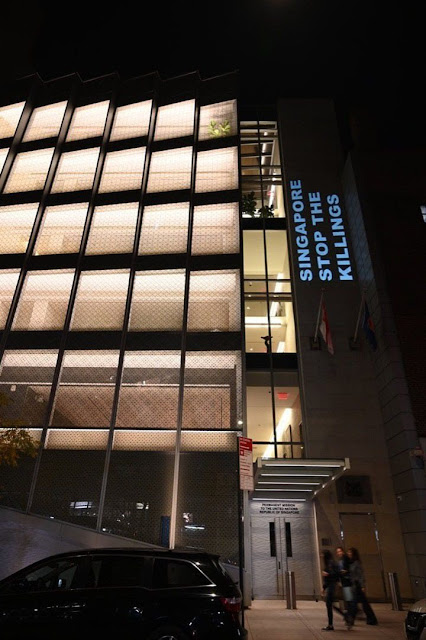
STOP THE KILLINGS

Image
 Weekly column written for the Singapore Unbound newsletter. Sign up here . Message “SINGAPORE, STOP THE KILLINGS” projected by  The Illuminator  onto the building  housing Singapore’s Permanent Mission to the United Nations on November 2, 2022.  The NYC-based Singaporean organizer explained, “The goal is to name and shame on the international arena,  to increase awareness outside of Singapore and show our support for those in Singapore fighting for justice."   The  shooting at Club Q in Colorado Springs  last Saturday, killing five people and wounding 17 others, was a tragedy. The repercussions of the shooting will live on, not only for the wounded and the families of the dead, but also for the LGBTQ community everywhere, who are reminded, once again, that they are not safe even in what is supposed to be a "safe space." Tragic in a different manner is the Singapore state's judicial murder of prisoners on death row. State-...

Recurring Motifs

JH's memorial was held last Saturday, November 12, at 150w83. PB managed to get through his speech without breaking down. It was a fine speech, loving, modest, and gently humorous. "Jin loved me but he also loved Anderson Cooper and Brazilian ballet dancer Thiago Soares." JH's mom spoke of JH's hospitalization in Fukuoka and PB's care for him in his last days. She too was puzzled by JH's sudden death and speculated that it was due to radiation as JH volunteered at the Fukushima prefecture in the last two or three years he visited Japan. In his speech JH's brother asked himself why JH moved to NYC, and thought it was because the city gave JH the freedom to be himself, freedom he could not find in Japan. He ended by asking us to keep NYC free, to which call many in the audience stood up and applauded. I could not help relating this to the election of Trump. The moment made a deep impression on me. I am committed to New York City and do not intend to leav...

Haiku

The long summer has led the bee astray... the cherries will bloom again in memory of Jin Hirata

Suicide and Haiku

TLS February 19, 2016 from Amia Srinivasan's review of Simon Critchley's Notes on Suicide : Most interesting is the suicide that heeds Seneca's dictum that the wise man "lives as long as he ought, not as long as he can". George Eastman, founder of Eastman Kodak, shot himself in the heart, leaving behind the note: "To my friends: my work is done. Why wait?" Hunter S. Thompson apparently felt that late was better than never: "67. 17 years past 50. 17 more than I needed or wanted. Boring . . . 67, you're getting greedy. Act your old sage. Relax. This won't hurt". Critchley admires this sort of end, sober and unentitled. But he is attracted most of all to suicide done for no apparent reason, as a leap into the absurd. He quotes approvingly from Edouard Levé's novel Suicide (Levé turned in the manuscript ten days before hanging himself): "Your death was scandalously beautiful". * Over the rocks the fall of water froz...

The Tombs of Ravenna

PN Review 42:2 November - December 2015 From Yves Bonnefoy's essay "The Tombs of Ravenna," translated by John Naughton: If nothing is less real than the concept, nothing is more real than this alliance between form and stone, between the exemplary and a body: nothing is more real than the Idea that is risked .  Ornamentation belongs to that category of beings that joins together in its profound purity the universal and the particular. It is the Idea made presence, and in the joy it awakens in us, I tasted the savor of a true eternity.  *  The universal is not a law that is everywhere the same and so never worth anything anywhere. The universal has its locale. In every place, the universal exists in the way it is looked at, in the way it is used.   *  Poetry and journey are of the same substance, the same blood - I am repeating what Baudelaire has said - and of all the actions that are available to man, these are perhaps the only useful ones, t...

In Memory of Bob Hart, gentleman-poet

I learned, with great sadness, from Eric Norris and a FB post by Jane Omerod that Bob Hart passed away on the morning of August 13, Saturday. I met Bob Hart at a Pink Pony reading at Cornelia Street Cafe, NY, in 2005. Or rather, it'd be more accurate to say that I heard him first. The mellifluous voice at the mic was strikingly different from anything that had gone before, and It made me sit up and take note. You know the sensation when you know you are hearing poetry, and not prose? Bob Hart never read any prose; he is, was, all poetry. The writing was lyrical, exploratory, musical and witty. It was inspired by the greats like Shakespeare and Donne. I got to know the man a little better when I edited and published his second book, Lightly in the Good of Day. When I asked to see his poems, he gave me a cardboard box filled with tissue-thin sheets of paper, covered with his slanty handwriting in blue or black ink. Over a decade of writing. He dated his poems, and the revisions, and ...

Banana Yoshimoto's "Kitchen" and Tse Hao Guang's "Hyperlinkage"

The two books are linked only by being carried in my bag to Fire Island last weekend. Banana Yoshimoto's book Kitchen is really two stories, a longer one, "Kitchen," and a shorter one, "Moonlight Shadow." Both deal with mourning for loved ones who died. After the death of her grandmother, her last relative, Mikage was "adopted" into the household of transgender woman Eriko and her son Yuichi. Neither Mikage nor Yuichi quite comes into focus, for me, as characters. It is Eriko, the embodiment of charm, who dominates the story with her personality, and whose death constitutes the true tragedy of the tale. She is Yoshimoto's update of the famous Chinese story by Li Yu, "A Male Mencius's Mother." The ending of "Kitchen" is charming. It is about the power of food, in particular, katsudon, to save one from numb despair. It reminds me of the nori-wrapped cucumber in Murakami's Norweigan Wood . The other story in the book, ...

Departures and NaPo 15

Departures , directed by Yôjirô Takita, is somewhat sentimental, but I could not help but be moved by the home-coming story. Daigo Kobayashi (played by a lovable Masahiro Motoki) gives up a musical career playing the cello and returns to his hometown. There he stumbles into the job of preparing corpses for burial, a work called nokanshi, or "encoffineer." It soon emerges that he is a man wounded by his father's abandonment at the age of six. By sending off the dead in a tender and professional manner, and thus comforting the mourners, he finally achieves consolation for himself. There is a wonderfully comical scene when Daigo has to model as the corpse for a training video featuring his boss and teacher Ikuei Sasaki (Tsutomu Yamazaki). The symbolism of the scene becomes clear gradually as Daigo undergoes a form of rebirth. spring wind walking to work no sweat!

Haruki Murakami's "Norwegian Wood"

Death is not the opposite of life but a part of it. This is what Toru Watanabe, the protagonist of the novel, learns from the suicide of his best friend Kizuki at the age of seventeen. Toru and Kizuki's girlfriend Naoko, joined by this incommunicable sadness, struggle in their different ways to live with the knowledge of death. The novel is a tender depiction of this struggle, its momentary successes, its relapses, its endurance. Naoko finally puts herself in a progressive mental health farm, Ami Hostel, in the hope of getting better. On a long bus ride to visit her, Toru passes through interminable cedar woods, broken only by small rural villages. The landscape of that bus ride becomes, very quietly, a metaphor for living with death. The supporting cast is vividly drawn. Reiko, Naoko's older roommate at the farm, is a wise, loving guitar-playing, Malboro-smoking presence. Nagasawa, who lives in the same student dorm as Toru, treats life as a test of will, whether he is out l...

Death as Radical Discontinuity

TLS August 2 2013 from Marci Shore's Commentary piece "Out of the desert: A Heidegger for Poland": [Krzysztof] Michalski's childhood had coincided with Stalinism in Poland; his adolescence with attempts to purify the Communist system of its Stalinist deviation without abandoning Marxism. At the core of Marxism remained Hegel's claim that "the truth is the whole". "Does the understanding of something suppose finding a unity in that which one wants to understand? Is it only then--when we are able in each fragment see a part of some whole--that we can discover some meaningin the multifariousness of the experienced world?" These questions, Michalski said in an interview, had kept him awake at night since his first years of university. They were at the heart of his book on Heidegger, published in 1978, and at the heart of his book on Nietzsche, published some thirty years later. Coud there be meaning--the kind of meaning that imbues life with v...

Poem: "Crow in Training"

Wrote this today. Crow in Training  condemned so many times/to be a crow      Claribel Alegría, “Ars Poetica” The first time the caw-caw surprised me so much that I dropped it like a burning stick. Second time I repeated the cry with my head cocked to a side, to better determine the iridescence of its report. Just before the third boy fell on his rifle, a bullet through his eye, I emitted so full and round a call that the grizzled veterans coughed approvingly. I counted off my triumphs of the day, seventeen —there were many of us cadets in the gathering.  The murder thinks my performance is promising.

Poem: "Skills"

Skills By an improved anguish      Laura Riding, “The Wind Suffers” As you would help a student organize her shifty thoughts in shapely paragraphs, stiffen the backbone of her sentences, clear up the verbiage and proof the spelling, you checked into a hospice, with his help, after you stopped the ill treatment of death. The passage would be lucid, you decided, with humor, dignity, and, you hoped, grace. So when the window rattled with the wind, like an excessive use of the em dash, you did not shush the weather with a comma but left it alone—the inspired break. i.m. Carol

Poem: "Singapore Buses Are Very Reliable"

I received my green card in the mail on March 1. GH left two official-looking envelopes on my table. One was a questionnaire to find out my eligibility to undertake jury duty. The other held my permanent residency. Responsibility and privilege come hand-in-hand, they say. I will have to live here for five years before I can apply for citizenship. I don't know yet if I will, since I am reluctant to give up my Singapore citizenship. Neither government encourages dual citizenship, unfortunately. I think I will try to write a poem about dual citizenship sometime. Last night, at the Son of a Pony reading, I shared the good news and the audience responded warmly. Then I read this poem, which I introduced as the other face of becoming a permanent resident in a foreign country. Singapore Buses Are Very Reliable And they told him that in Prague his mother died.             Polina Barskova, “Motherhood and Childhood” ...

Poem: "In Death As In Life"

In Death As In Life In some city, Trieste or Udine…             Pier Paolo Pasolini, “The Day of My Death,” translated by Mary di Michele Your mother wants her body donated to science, she wants             to be useful in death as she is in life,             to brain,             eye, uterus, and even skin researchers. She wants to be all used up. We are more selfish. You wish             to be cremated and for your ash to run across             the Great Lawn             we live by, lift off like a warm grey scarf         ...

Poem: "Tracing Death"

Tracing Death We trace the pow’r of Death from tomb to tomb                         Phillis Wheatley, “To a Lady on the Death of Three Relations” The life that sailed from sight, the life to come, the life that scribbles softly in between— we trace the pow’r of Death from tomb to tomb. A woman fell backwards, stunned in her womb. Extracted from her dry eyes by the men the life that sailed from sight, the life to come. Elsewhere a bride is waiting for her groom, around her mouth sweat gathers to a sheen. We trace the pow’r of Death from tomb to tomb. Studying Virgil in the children’s room, the slave hears from the Carthaginian queen the life that sailed from sight, the life to come. The writing starts, and stops, and then resumes. In graceful elegies out of her pen, we trace the pow’r of Death from tomb to tomb. Pray for u...

Susan Howe's "That This"

That This , about the death of Howe's husband, the philosopher Peter Hare, is an odd and sometimes beautiful book. The three parts that make up the book are very different, one might even say, at odds. Or so they seem. The first part titled "The Disappearance Approach" is a rather conventional arrangement of diary-like prose entries. Beginning with the discovery of Hare dead in his bed, it proceeds by weaving fragments of memories with reflections on Jonathan Edwards and his family, Milton, W.H. Auden, Nicolas Poussin, and Ovid. The literary and artistic references give a sense of the couple's shared life, the Edwards reinforcing the New England connection, but they are also a rather familiar device to raise the tone and deepen the significance of one's loss. Nothing particularly memorable is said about the writers. After quoting from a letter by Sara Edwards telling her daughter of Jonathan's death, Howe comments, "I love to read her husband's an...

Poem: "Copy"

According to  Writing: The Story of Alphabets and Scripts , by Georges Jean, when medieval scribes overlooked a line of writing, they would write it in the margin or at the bottom of the manuscript, and draw an arrow from it to the place where it should have appeared. The artist would even decorate the arrow with drawings of plants and animals climbing up the line of reparation. This wonderful detail coalesced with my reading of Susan Howe's That This , a book of poems about her husband's death. The book is made up of three parts. The third part, also the title sequence, "delivers beautiful short squares of verse that might look at home in a hymnal" (back cover). Most of the poems there consist of two couplets separated by stanza break. I follow that pattern in my poem "Copy" and include a missing line at the bottom of the poem, a line which should be re-inserted into the stanza break, where it belongs, with an arrow. The epigraph is from the first part ...

Desire and Unseen Orders

TLS January 12 2011 from Julian Bell's review of Deanna Petherbridge's The Primacy of Drawing: Histories and theories of practice : ... Klee's notion of "taking a line for a walk", or Matisse's "desire of the line"... *** from John Ray's review of British Museum exhibit "Ancient Egyptian Book of the Dead": O my heart of my mother, my heart of my forms, do not stand against me as a witness, do not oppose me in the tribunal, do not incline against me in the presence of the Keeper of the scales, for you are my spirit which is in my body, the god with the potter's wheel who moulded and made safe my limbs. Go on to the happy places to which we speed. In ancient Egypt, these were the words that were needed during the judgement of the dead. The subject's heart is being weighed in a balance, in the presence of the most awesome of the gods. In the opposite pan of the scales is the feather of truth, and the heart of the righteo...

Poem: "No Snow Day"

No Snow Day We counted on a Snow Day, counted on impassable roads, on schools closed at long last, even if for a day, counted on sledding in the morning and, when tired of the wind flattening our face, counted on shimmying under our sheets to feel the cold melting into a pool, we counted, we did, on a Snow Day, on being irresponsible as the dead, on a likable stammer, a shuteye, but the snow never came.