Posts

Showing posts with the label Shakespeare

Stephen Greenblatt's WILL IN THE WORLD

 Compulsively readable. Some of the links are highly speculative, but the dots are connected in a pleasing pattern.

Catching Up with Books Read

The Tempest (Norton Critical Edition, Second Edition). The play that makes me feel closest to Shakespeare. This superb critical edition provides very useful sources, criticism, and creative responses to the play. An essential tool for teaching the play. Wole Soyinka's Death and the King's Horseman .  Caliban speaks and shows that he can do more with the English language than to curse. The Norton Critical Edition has a terrific essay by Kwane Anthony Appiah about the disingenuousness of Soyinka's claim that the play is not about a clash of cultures.  Roberto Bolaño's The Spirit of Science Fiction .  An entertainment. When we were young and heroes to ourselves, if to no one else. Ralph Ellison's Invisible Man .  Brutally hilarious. The run-in with the Communists is a powerful warning never to allow oneself to become a System man.

Where Is Edgar When You Need Him?

Weekly column written for the Singapore Unbound newsletter. Sign up here . Of all the characters in Shakespeare's King Lear, it is hardest to sympathize with the Duke of Gloucester. Neither plainspoken like his banished peer Kent nor levelheaded like Lear's disowned daughter Cordelia, Gloucester wavers between the old authority of Lear and the fresh powers of the new rulers, trying to placate both. Accommodation is the nature of his character and politics. How ironic then, when he finally throws in his lot with the old king, he should be blinded by his young bosses and cast out of his own house. And yet Shakespeare found in him a man, more, an emblem, of the playwright's own era. Driven by despair, Gloucester asks the mad beggar Poor Tom to lead him to the cliffs of Dover, where he intends to kill himself. Why the cliffs of Dover? Why not the simpler solution of swallowing poison or welcoming a sword? Perhaps it's because Gloucester wishes to dramatize, to himself,...

Poems in BPR

Image
I have three poems in Birmingham Poetry Review (Spring 2018 number 45), a publication of the University of Alabama at Birmingham. The issue features the great poet Gerald Stern with new poems written in his 90s, and a perspicacious essay by Lucy Biederman on him titled ""And I Go On and On": Gerald Stern's Poetics of Protest." It's bracing to read about how Stern has integrated his politics into his poetics from the start. Some terrific poems in the issue. I particularly enjoyed Saara Myrene Raappana's "Heroic Origins" (it's about bees), Chelsea Rathburn's "The Corinthian Women" (who stood aside while Medea murdered her children), and Gary Soto's two Untitled poems based on Henry V 4.1.98-99 and the bard's Sonnet 150.9. Thanks, Adam Vines and Gregory Fraser, for accepting my poems. Annual subscription is only $10.

The Self-Propelled Island

Two Fridays ago, went gallery hopping with VM not in Chelsea, but on the Upper East Side. Saw a retrospective of David Hammons, the foremost African American conceptualist artist, at Mnuchin Gallery. The most striking work was his Basketball Chandeliers. Also saw portraits and landscapes by Jean-Michel Basquiat, including four paintings of cows and goats. We ended up at the Met, to look at Turner's whaling pictures, before having a drink at the gallery bar. * TLS April 8, 2016 from Pippa Goldschmidt's review of Jules Verne's The Self-Propelled Island , translated by Marie-Therese Noiset: By contrast, in The Self-Propelled Island, published much later, in 1895, this optimism is tempered with a greater sense of realism; now technology is primarily an enabler of hubris. The novel is set in an apparent utopia; a vast island inhabited only by millionaires which floats around the Pacific, hardly ever needing to dock in its home country of the United States. Only the very...

Mystery Plays and Dancing Space

TLS July 24, 2015 from Gerard Kilroy's review of Mortal Thoughts: Religion, secularity and identity in Shakespeare and early modern culture by Brian Cummings; The Bible in Shakespeare by Hannibal Hamlin; and A Will to Believe: Shakespeare and religion by David Scott Kastan: Cummings explore the "condition of soliloquy" in the Confessions - "et cum ipso me solo coram te" (with myself all alone in front of you) - in one of the most rewarding chapters in the book, "Soliloquy and Secularization". Augustine is seen as the source both of the word "soliloquy" and of the genre. The soliloquy is both a meditation and a dialogue between an interior self that is true, and an interior self that is mutable and transitory. Long before Hamlet's most famous of soliloquies, Cummings finds Augustine in De libero arbitrio , meditating on not being: "It is not because I would rather be unhappy than not be at all ... , that I am unwilling to die...

Old Work, New Work, Public Work

Image
Shakespeare's Globe is in New York, and I was lucky to get two tickets to the production of Richard III at Belasco Theatre last Friday. Disconcertingly, Mark Rylance played Richard for laughs, and achieved a new horror. Liam Brennan was brilliant too as Clarence, as was Paul Chahidi as Hastings. The rest of the cast was below par. It was an all-male cast. Of the men playing the women, the strongest was Joseph Timms as Lady Grey. The scene in which Richard tried to persuade Lady Grey to give her daughter to him in marriage was both funny and heartbreaking. Rylance's comic timing, aided by a stutter, turned seemingly innocuous lines into bombshells of laughter. Yesterday was a beautiful, brisk day for gallery-hopping. GH and I saw the new sculpture by Richard Serra. Inside Out (2013), a single work made out of two curved plates, was tremendous. You think you know Serra's signature monumental work, and will therefore be unmoved by it. But I was, yet again, at the Gagosian g...

Set Honor in One Eye and Death i' th' Other

Saw the Donmar Julius Caesar at St. Ann's Warehouse last night. I liked the concept very much. The play-within-a-play was set in a women's prison. Two levels of meaning ran simultaneously through the play. Shakespeare's Roman world of ambition and betrayal. Also, the modern prison system, with its goal of reform and lust for spectacle. The women were Caesar, Brutus, Cassius, Portia, Calpurnia and so on, but they were also tough broads, rightly or wrongly incarcerated. In that criminal world, Harriet Walter playing Brutus seemed to come from a different sphere, or from a different play. Her noble poise and her classical training fitted awkwardly with the rest of the cast. Jenny Jules as Cassius took some warming to, but was the most sympathetic figure by the end of the play. I loved the originality of having Mark Anthony (Cush Jumbo) sprawling on the floor, surrounded by a gun-toting mob as he started on his famous funeral oration, but the speech quickly became predictable...

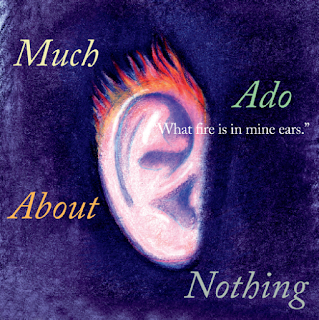
"What fire is in mine ears"

Image
Last night, GH and I watched the production of Much Ado About Nothing by the Theatre for New Audience, at the Duke on 42nd Street. The performance, very well directed by Arin Arbus, was crisp and funny. The only truly bad idea was to have John Keating play Verges like Kramer from the sitcom Seinfeld . Maggie Siff was a terrific Beatrice, rapier-sharp and emotionally nuanced. Jonathan Cake, as Benedick, had some good moments, but relied too much on the physical tics of American sit-coms. Neither Michelle Beck as Hero nor Matthew Amendt as Claudio was particularly memorable. However, Robert Langdon Lloyd, who played Leonato with such noble civility in the first three acts, achieved a tragic intensity in Act Four befitting King Lear when he ranted against Hero for her supposed immorality. Don Pedro (Graham Winton), the Prince of Aragon, broke the illusion by stumbling over his lines a few times, though it was opening night. Saxon Palmer who played his bastard brother Don J...

Lois Potter's "The Life of William Shakespeare"

Image
I enjoyed Lois Potter's The Life of William Shakespeare tremendously. Subtitled "A Critical Biography," the book looks at all the works by the Bard not only as literary artefacts but also as living process. On the poems, she observes the pressures on an ambitious young man aspiring to make his mark on literary London. On the plays, she is particularly acute on Shakespeare and his collaborators. She is also sensitive to how the plays were written or adapted to capitalize on star actors and boy performers. Different audiences, whether at the theaters or the Inns of Court or the royal palaces, accounted for different versions of the plays. Publication of the plays were economic and political decisions, and not just literary ones. The process of producing the work was messy, contingent, opportunistic, and it is a testament to Potter's writing that she is able to bring a clarity of form to her mastery of detail. One useful device is to begin every chapter with a quota...

No Diagnosis

Life's but a walking shadow, a poor player that struts and frets his hour upon the stage and then is heard no more. It is a tale told by an idiot, full of sound and fury, signifying nothing. The production of Macbeth by the National Theatre of Scotland that GH and I watched last night took the despairing speech above and made it literal. Set in a psychiatric ward, which filled the entire Rose Theater stage and so dwarfed any human action, the production starred Alan Cumming as a mental patient who played all the major roles of the play. Cumming put in a virtuosic performance, switching from character to character fluently, declaiming almost non-stop for 1 hour 45 minutes. But the virtuosity of the performance created a problem for me. I was so engrossed in looking out for the switches that I was never fully immersed in the drama. The characters might have been cleanly delineated by the actor but they were not fully inhabited. Could they be, by any single actor? Perhaps the...

Ralph Fiennes's "Coriolanus" (2011)

I am not into modern updates of Shakespeare, especially those with a political axe to grind. Such updates seem to condescend to the audience, as if we cannot be trusted to draw our own conclusions from a straight production of the Elizabethan Shakespeare. In movies, the contemporary imagery also tends to overwhelm the Shakespearian language. Ralph Fiennes's modern adaptation of Coriolanus does not escape these pitfalls. The battle scenes, set in a war-torn city that could be Baghdad or Kabul, could have been lifted from any number of modern combat movies. The riot for bread played like an angry protest on TV. I was also struck by how inefficient film conventions are compared to those of the stage. When Coriolanus approached Aufidius to offer himself as an ally, the camera followed Coriolanus slowly through a dark tunnel to the enemy headquarters. On stage, he would have just appeared in Aufidius' presence. But Fiennes managed to capture on the big screen the nuances of the c...

Sam Mendes's "Richard III"

Last night, at the BAM Harvey theater, Richard III , directed by Sam Mendes, played to a full house. The production was the last to be mounted as part of The Bridge Project, a British-American collaboration. I enjoyed the Project's King Lear last year, the eponymous hero played by Derek Jacobi, and so looked forward to the play about the infamous, hunchbacked king.  Kevin Spacey, as Richard, was disappointing. His performance stayed on a single note, that of a growling menace, that did not have any shade or space in it. His seduction of Lady Anne was utterly unconvincing because there was no charisma or sex appeal in the portrayal. The humor when speaking lines that are not supposed to be humorous was broad, almost farcical. Richard was almost a cartoon character in Spacey's hands. The other actors were not particularly memorable, except two. Chandler Williams played the Duke of Clarence with restrained dignity. The scene of his execution was poignant, the tragedy accent...

Grandage's "Lear" and Balanchine's Dances

Last Thursday I watched the Donmar Warehouse production of King Lear at the BAM. Derek Jacobi played Lear as a childish old man, an interpretation that robbed the play of some of its pathos, I think. He was electrifying, however, in the mad scene, in which he and blinded Gloucester (played by Paul Jesson) became ironic pastoral figures. The final scene, in which he entered carrying the dead Cordelia (played by a lackluster Pippa Bennett-Warner), was extremely moving. Michael Hadley was a negligible Kent. Alec Newman was a shabby Edmund who did not look capable of seducing tortoises, let alone queens. As Goneril, Gina McKee had an interesting voice, somewhat metallic. Justine Mitchell was always on the verge of tears, if not actually crying, as Regan. Tom Beard was a convincingly ineffectual Albany. Gideon Turner looked too young and wild to be Cornwall. Gwilym Lee was fine as Edgar, solid but not revelatory. The most charismatic presence on stage was Ron Cook as the Fool. He was bri...

A Moor in Boston

Third day in Boston, last Friday, SK and I went university visiting. We walked round Harvard Yard and into troops of Chinese students touring what could be their future alma mater. SK told me that in China there is a flourishing industry whose sole service is to get local students into American Ivy League schools. The last time I was here, six years ago, it was winter and the Yard was brown and hard. Now I was struck by how green it was. The Harvard Museum of Natural History put on a special exhibition on evolution. The exhibition text was somewhat strident in tone. It insisted that the theory was supported by "overwhelming evidence" and repeated that the theory was a "fact." I loved the glass flowers as much as I did before. So many grasses on display, that the show might be better named Leaves of Glass. We had lunch at the popular Bartleby's Gourmet Burgers. There was a long line. My Michelle Obama (cajun, goat cheese) was good, but nothing special. After ...

Shakespeare Retold

I enjoyed these modern adaptations by the BBC. The plot on the back cover: Macbeth is the chef in a three-star restaurant, slicing apart his celebrity boss, Duncan. Beatrice and Benedick are rival co-anchors on a nightly newscast whose open hostility masks passion of a different kind. . . . And the eccentric aristocrat Petruchio sets out to tame the conservative MP Kate in a politically incorrect marriage of convenience. Of the three I watched, I enjoyed The Taming of the Shrew best. Shirley Henderson was an unforgettable Kate, small, nasty, winning. Rufus Sewell was convincing as a brutal, childish and cross-dressing aristocrat. In Much Ado About Nothing , Sarah Parish and Damian Lewis were charmingly antagonistic. Tom Ellis (Claude) was a dreamboat. I did not enjoy the film-noirish Macbeth at first, but then got into it. James McAvoy made it very watchable. The bloody special effects were also terrifically chilling.

Human Varieties and Universals

TLS February 12 2010 from Ben Hutchinson's review of Frederic Hölderlin's ESSAYS AND LETTERS, edited and translated by Jeremy Adler and Charlie Louth: Yet by 1797, Hölderlin is moving away from philosophy, writing to Schiller that "I now consider the metaphysical mood as a certain virginity of the mind". In 1798, he writes that philosophy is a "hospital where poets afflicted as I am find honourable refuge", and by 1799 he foes so far as claim hat he has made himself unhappy by cultivating "activities that seem to be less well-suited to my nature, such as philosophy". . . . Like the early Nietzsche, whose distinction between the Dionysian and Apolline he seems here to anticipate, Hölderlin looks to the Greeks to unite poetry and philosophy, speaking admiringly of the "strictness with which the ancient writers distinguished between the different kinds of poetry". * Achilles represents for Höolderlin the "ideal being", since Ho...

Fiasco Theater's Cymbeline

Access Theater was not easy to get to. Located south of Canal Street, and not in the usual theater neighborhoods, it perched at the top of eight flights of steps. You might also mistake the other small theater on the same floor for it, as I did, since there were no signs except for xeroxed posters of Fiasco Theater's production of Cymbeline . But access is not just a matter of geography, of course; it is also emotion and physicality. The last two Fiasco Theater had in spades in their exhilarating performance. No fancy stage sets or props to hide behind.  Just 6 actors and a trunk. With tremendous joyful energy, they pumped Shakespeare's late romance for all its poetry, comedy, melodrama and, yes, tragedy. The scene in which Belaria and the boys mourned over the supposedly dead Imogen was heart-breaking. The pathos turned abruptly, magically, into silliness when Imogen revived and touched the headless Cloten. Instead of smoothing out the play's mixture of genres, this prod...

"Hamlet" directed by Michael Grandage

The production from The Donmar Warehouse in London comes to Broadway, at Broadhurst Theatre. TH and I watched it on Tuesday. I think SS is right when she said Jude Law, as Hamlet, tried too hard. He did not manage to shake off his celebrity and immerse himself into the role, but overacted to the point of caricature. Contrary to his own advice to the players, he sawed the air too much with his hands. Kevin R. McNally's Claudius was a defensive dictator. In his poignant prayer scene, you almost want to forgive him for killing his brother and king. I did not like Geraldine James as Gertrude: her queen looked the part but had no center. Peter Eyre was a very human Ghost, and an extraordinary Player King. His speech about Hecuba was the best thing in the performance. He recited the speech as a whole, living thing; Jude Law recited his soliloquies line by line. Ron Cook had Polonius down to a T. Gugu Mbatha-Raw as Ophelia came up with only inconsistency. I could not understand a word o...

Nietzsche's "The Birth of Tragedy"

Nietzsche published this essay in 1872 at the age 27. He explains the birth of Greek Tragedy by focusing on the chorus, which existed before drama, and gave rise to it. The chorus, sung by satyrs, and devoted to the worship of Dionysus, was deeply associated with the god. Its dithyrambic music invited union with all of nature, and loss of individuation. When this music was cast into an image, in the form of the dramatic scenes, Tragedy was born. This clarification into image and persons Nietzsche associates with Apollo. The sweet calmness of the Greeks was Apollinian (Walter Kaufmann, the translator, follows Nietzsche's spelling), but Nietzsche's point is that we cannot fully appreciate Greek civilization if we do not understand the Dionysian passions it brought under control. Less persuasively, Nietzsche associates the death of Greek Tragedy with Euripides. In the later playwright rose the spirit of Socrates, whose rationalism destroyed the power of the Greek myths. So Euripid...