Posts

Showing posts with the label History

David Nirenberg's ANTI-JUDAISM: THE WESTERN TRADITION

An immense scholarly achievement. Erudite, persuasive, and gracefully written, it is the kind of intellectual history that changes our understanding of ourselves, our ideas, our cultures, and our world. Yes, it focuses on the strain of anti-Judaism in Western thinking, but it is also about the making and writing of history more generally. Particularly I learned from its analysis of Marx. That in critiquing the evils of capitalism, Marx not only deployed the hated figure of the Jew, but also claimed the figure's reality in society. He thought he was doing sociology as well as economic theory, and so opened the possibility to future persecution of "real" Jews. It is too easy to slip from capitalism to Jewry in one's thinking. A fault that plagues the Left. 
George Chauncey's GAY NEW YORK

 The full title of the book is  Gay New York: Gender, Urban Culture, and the Making of the Gay Male World 1890-1940 . Subtle analysis combined with plenty of interesting detail makes this a terrific read. The style is not at all academic, and yet the rigor is so. The research into visual and textual documents held by a wide range of sources, such as purity movements, the police, local newspapers, doctors' reports, is impressive, and the documents themselves are read with sensitivity and insight. My biggest takeaways are (1) when the fairy, the emblem of the period, gives way to the gay, the view of queer men changed from being a gender status to a sexual identity, and (2) the notion of heterosexuality arose together with the notion of homosexuality, when the white middle-class men felt threatened by women's social progress and the fairies' increasing visibility. 

Freud and the Non-European

 A brilliant reading of Freud's Moses and Monotheism by the late Edward Said. It originates as a talk given at the Freud Museum in London. After Said's talk, Jacqueline Rose responded, and her response was fittingly included in the Verso book. Said concludes: "Freud's uneasy relationship with the orthodoxy of his own community is very much a part of the complex of ideas so well described by Deutscher, who forgets to mention what I think is an essential component of it: its irremediably diasporic, unhoused character. This is a subject which George Steiner has celebrated with great elan for many years. But I would want to quality Deutscher by saying that this needn't be seen only as a Jewish characteristic; in our age of vast population transfers, of refugees, exiles, expatriates and immigrants, it can also be identified in the diasporic, wandering, unresolved, cosmopolitan consciousness of someone who is both inside and outside of his or her community. This is now ...

Speech Bubbles

Image
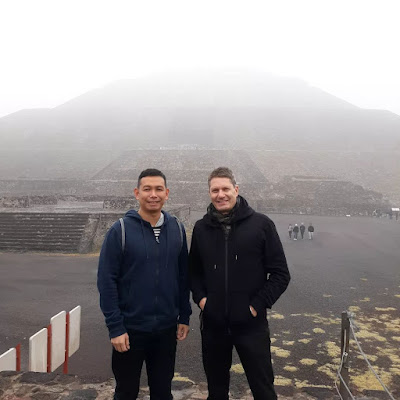
When we arrived yesterday, the Pyramid of the Sun was covered in fog. The misty cover disappeared in the course of the morning, by the time we took our photo in front of the Pyramid of the Moon. The whole complex was truly impressive. What we did not expect was the colorful murals in the complex and surrounding residential ruins. In the murals, the liquid-shaped things coming out of mouths are speech bubbles. Can you spot the "football player"? Our guide Rogelio from With Locals was excellent. He was informative and skeptical at the same time, very unusual for a tour guide.   Back in the hotel, started watching The Witcher: Blood Origin , with Michelle Yeoh in it. Then found out on IG that Henry Cavill has been dropped from both Superman and The Witcher. When Guy joined me, we watched Glass Onion , with Daniel Craig as the detective and Edward Norton as the Meta-like CEO. Not brilliant by any means, it was worth watching.

THE BLACK JACOBINS: Toussaint L'Overture and the San Domingo Revolution, by C.L.R. James

 A rousing historical narrative, impassioned, clear-sighted, and deeply knowledgeable. About the British effort at the abolition of slavery in the latter half of the 1780's: "It was the miraculous growth of San Domingo that was decisive. Pitt found that some 50 per cent of the slaves imported into the British islands were sold to the French colonies. It was the British slave-trade, therefore, which was increasing French colonial produce and putting the European market into French hands.... By 1786 Pitt, a disciple of Adam Smith, had seen the light clearly. He asked Wilberforce to undertake the campaign. Wilberforce represented the important division of Yorkshire, he had a great reputation, all the humanity, justice, stain national character, etc., etc., would sound well coming from him. Pitt was in a hurry—it was important to bring the trade to a complete stop quickly and suddenly. The French had neither the capital nor the organization to make good the deficiency at once and ...

We've Got People

Howard Zinn's A People's History of the United States delivers as promised. A passionate and compelling account of American history from the point of view of its peoples: the indigenous and not the invaders, the enslaved and not the slavers, the working class and not the governing class, the minorities and not the majorities. Without glossing over the fractures, contradictions, and limitations of mass movements, yet Zinn offers a glimpse of their power and achievements. America has always had its radicals, much as it has always had its oppressors. I will be returning to this book again and again for its understanding, compassion, and outrage. Ryan Grim's We've Got People is an exciting journalistic account of the rise of the American progressive movement from Jesse Jackson in the 1980's to Alexandria Ocasio-Cortez in the 2010's. In Grim's account, Rahm Emanuel emerges as the arch-villain who led the Democrats astray by taking money from big corporations in ...

Cebu Day 1-3

First visit to the Philippines. Arrived in Cebu on Wednesday. Had dinner in Jollibee near the Maxwell Hotel. On Thursday, visited the Basilica Minore del Santo Niño. The Christ child is the patron saint of Cebu, but a child with dark skin and black curly hair. Devotees lined up to pray to the icon in the chapel but there were replicas for sale in the church gift shop too. Replicas in the basement museum too, which are for traveling around the country and for bathing in the sea on a holy day. Along the cloisters of the church were paintings and stories about the miracles of the Child. The Tuba (drink) Provider. The Fishmonger (the Child plays a prank on a seller of fish). The Patriot (The Child signs up to defend the Philippines). The Speedy Boater. The Rainmaker. Beautiful and cool garden in the middle. Woman sitting under the shade of the Church. Saw Magellan's Cross behind the basilica. Walked through the Carbon market to Ermita neighborhood, which reminded me of Goh Poh Seng...

Time to Open the Archives

Weekly column written for Singapore Unbound's newsletter. Sign up here . "They came to the coffee shop in Joo Chiat where I was working at 2am. About five or six officers came, and they took me to Outram [police station], where there were already many people. I was detained for four and a half years. I was a Singapore citizen but I lost my citizenship; they took me to the border. I couldn’t return to Singapore for years...." YEH Kim Pak was 27 years old when he was arrested on February 2nd, 1963, along with over 110 anti-colonial activists on the mere suspicion of being Communists. Yeh was not a Communist, but he did fight for workers' rights through the Singapore Coffee Shop Employees Union. The British police operation, codenamed Cold Store, was supported by the Malaysian and Singaporean leaders who used it against their political opponents. In fact, there is evidence that Singapore's leader LEE Kuan Yew urged the reluctant British authorities to...

Invitation to an Insurrection

A weekly column written for Singapore Unbound's e-newsletter. Sign up here .  Dueling Narratives About Colonial Rule In the early morning of September 28, 1901, Filipino revolutionaries, led by local police chief Valeriano Abanador, attacked the American garrison stationed in Balangigi, on the island of Samar. They killed 36 and wounded 22 in action. In retaliation, the Americans swept through the island, burning villages and killing anyone, men and women, above the age of 10. Their order was to make Samar "a howling wilderness." Estimates of the number of casualties range from 2,500 to 50,000. In her new novel INSURRECTO, Gina Apostol approaches this historical incident of colonial brutality through the dueling narratives of an American filmmaker and her Filipino translator. In the process Apostol also tells the stories of women artists and revolutionaries, daughters and lovers, coming to an understanding of the truth of their lives, including one Casian...

Dolphins

PB invited me to join him last Sunday to watch documentary on the US incarceration of Japanese Americans during World War II. Part of the 11th Annual Peace Film Festival, organized by Yumi Tanaka and a band of volunteers, Resistance at Tule Lake (2017) by Konrad Aderer was less about the resistance than about the remembrance of this infamous episode of American history. Tule Lake camp was where those who refused to answer, or answered no-no to, the government's loyalty questionnaire were sent. There was a special segregation center inside the camp for those judged especially resistant or disloyal. The government also mounted a campaign to persuade the prisoners of all ten concentration camps to give up their US citizenship and be deported to Japan, even though most of them had never seen that country. Fearful and angry, many Tule Lake camp inmates joined the pro-Japan faction called the Hoshi-dan. The film showed them running in squads and doing other physical exercises to train t...

Jewish Mysticism

Last Monday, had dinner with Kevin Maxwell at Grand Szechuan, Chelsea. He had been with his friend Fahdi, who was dying of cancer. On Thursday, Kevin posted on FB that Fahdi had died. I met Fahdi only once, at a birthday dinner for Kevin. He was a psychologist or psychiatrist. He was into big biceps. Tuesday, attended the second session of the Gershom Scholem course at the Center of Jewish History, taught by Izhak Lewis. The readings and discussion turned on Scholem's study of Jewish mysticism. Is there such a thing as mysticism across time and space, or is it constituted as an object by academic study? Wednesday, had coffee with Matt from Shelf Awareness. Then dinner with Kim and Judy Luo, who was applying to be editorial intern with Gaudy Boy. Flora Chan joined us and showed us her cover designs for Malay Sketches . Thursday, GH and I watched Annie Hall . Friday, we watched Beach Rats (2017), which suffered from bad writing but had a rather good Harris Dickinson as a druggi...

Vicente L Rafael's Motherless Tongues

Thought-provoking essays on post-colonialism, neo-colonialism, translation, and the insurgency of language. Looking at the Philippines at the time of its Revolution, American occupation, and "People Power" II, and at the USA after 9/11, Rafael traces the attempts by colonial and neo-colonial powers to master translation in order to subjugate local populace. Each time he shows that the powers fail because of the insurgency of language, that which cannot be translated. Particularly interesting to me is the idea of the radical welcome that Revolution shows to the Other. Also fascinating is the failure of American schooling to eradicate Tagalog and other vernacular idioms and accents. The Introduction speaks eloquently of the suppression of other languages in order to speak and write in scholarly English. The final essays on Filipino scholars--Renato Rosaldo and Reynaldo Ileto--are appreciative of their achievements while remaining alert to their limitations. Of the latter's ...

Motherless Tongues and Haiku

Last night at Asian American Writers' Workshop, I heard Leila Chudori read from her newly translated novel Home , followed by Vicente Rafael reading from Benedict Anderson's memoir A Life Beyond Boundaries . The discussion was moderated by Gina Apostol. Rafael, a former student of Anderson's, and Professor of History at the University of Washington, was really sharp. In his reading, he put together a collage of extracts that focused on the role of luck in a life. According to Rafael, Anderson once noted that "luck" does not appear in the index at the back of any scholarly book: it is outside the boundaries of academic inquiry. If Benedict was not expelled from Indonesia for contradicting the Suharto regime's explanation of the 1965 massacre, he would not have lived in Thailand and the Philippines, and written his innovative comparative study on nationalism, Imagined Communities . During the Q&A, Rafael explained Anderson's ideas very succinctly in resp...

Sip-in

Image
Last night BV and I attended a talk at Jefferson Market Library to commemorate the upcoming 50th anniversary of an early instance of gay activism in New York City. "Fifty years ago a person could be refused service in a bar simply for being gay, and his or her mere presence there could result in the bar’s closure by the State Liquor Authority. On April 21, 1966, Dick Leitsch and other members of the Mattachine Society, an early LGBT rights organization, staged the now famous Sip-In at Julius’ bar in the Village to challenge this “legal” discrimination. After they announced to the bartender that they were homosexuals and wished to be served, they were refused service. The event generated publicity and was one of the earliest acts of organized LGBT civil disobedience in New York City. Scholars of LGBT history consider the Sip-In at Julius’ as a key event leading to the growth of legitimate LGBT bars and the development of the bar as the central social space for urban LGBT New York...

Antonio Tabucchi's "Time Ages in a Hurry"

I am grateful to translators Martha Cooley and Antonio Romani for introducing me to the short fiction of Antonio Tabucchi. Time Ages in a Hurry collects nine stories: "The Circle," "Drip, Drop, Drippity-Drop," "Clouds," "The Dead at the Table," "Between Generals," "Yo me enamore del aire," "Festival," "Bucharest Hasn't Changed a Bit" and "Against Time." The stories are closely observed, often revolving around two people in conversation. The late Italian writer is profoundly concerned with the passing of time and its effects on memory, desire and fantasy. In the very poignant "Drip, Drop," a man waits beside his dying aunt, who has taken custody of not only him as a young boy, but also the childhood memories that he was too young to remember. The stories do not stay in Italy but range across Europe and beyond. "The Circle" is narrated from the perspective of a woman from t...

Hard Choices: Challenging the Singapore Consensus

A thought-provoking set of essays. The main writer Donald Low is persuasive about how widening income inequality in Singapore is destroying the social compact between the government and the people. He argues for income redistribution and the strengthening of social nets, and against the shibboleths that stand in the way, such as elite belief in trickle-down economics, moral hazard, and decreased global competitiveness. He wants policy-makers to look hard at the empirical evidence, instead of being confirmed in their prejudices by past experience raised to the status of ideology. Low is particularly good at using insights from cognitive research to explain why the governing elite is so slow to adapt to a fast-changing environment. His reliance on such findings is telling. He mainly believes that governmental failure is primarily a failure in thinking. Correct the thinker, and he will correct his policies and processes. At one point, Low assures the reader that the governing elite that...

Deep Gossip and Haiku

I met Henry Abelove at Dorothy Wang's book party, and was introduced to his book of essays called Deep Gossip . The title is taken from Allen Ginsberg's elegy for Frank O' Hara. After describing O'Hara as a "Curator of funny emotions," Ginsberg praises him for his ear "for our deep gossip."  The essays are as engrossing as gossip, an apt compliment if we think of gossip as the sharing of information between disempowered people. In these essays, Abelove  performs careful and gracious corrections to what has been underestimated, overlooked and sidelined.  Like many gay men, I have read Freud's letter to the American mother, but had not realized that it was his last riposte to the moralism of American psychoanalysts. In the next essay, the suggestion that other sexual practices besides "intercourse so-called" have been redefined as foreplay in the late eighteenth century is brilliant.  Since I am not a fan of marriage, Abelove's read...

H. W. Brands's Biography of FDR

Written with a full appreciation of Roosevelt's accomplishments and a frank understanding of his flaws, Traitor to His Class is an engrossing read. The chief burden of the book is to explain how a man of Roosevelt's class and privilege could have become so firm a supporter of ordinary men and women, and so visionary an architect of American internationalism. Part I "Swimming to Health 1882 - 1928" covers the early period, right up to his becoming the Governor of New York. Part II "The Soul of the Nation 1929 - 1937" traces his path to the Presidency and the implementation of New Deal as a response to the Great Depression. The final part "The Fate of the World 1937 - 1945" examines America's entry into WWII and FDR's record as Commander-in-Chief. I was intrigued to learn that, in a moment of carelessness, FDR promised Winston Churchill to send American troops to defend Singapore. The Atlantic Charter was an important document supporting sel...

The Foucault Reader

After encountering the critical thought of Nietzsche, I have wondered how to apply it to social and political problems. Foucault shows one way of doing so, through the genealogical analysis of power relations in society. From an interview in Power/Knowledge : The history which bears and determines us has the form of a war rather than that of a language: relations of power, not relations of meaning. History has no "meaning," though it is not to say that it is absurd or incoherent. On the contrary, it is intelligible and should be susceptible to analysis down to the smallest detail--but this in accordance with the intelligibility of struggles, of strategies and tactics.... What makes power hold good, what makes it accepted, is simply the fact that it doesn't only weigh on us as a force that says no, but that it traverses and produces things, it induces pleasure, forms knowledge, produces discourse.... From the essay "Nietzsche, Genealogy, History": Human...

Frank Ching's "Ancestors"

It is a curious thing to me that I am non-curious about my ancestors. I read to discover literary ancestors--predecessors and mentors--who can give me help. I cannot imagine spending years of my life, as Frank Ching did, researching actual ancestors, as if they have anything to do with me but for the accident of blood. Would I feel different if I discover how illustrious my ancestors are, like Ching's list of top court officials, brilliant scholars, famous poets, noted failures, and even a notorious traitor? Though illustrious, their lives in dynastic China followed the same basic pattern, which makes for dull reading. These men (for only scholar-class men had their lives recorded in government, city or clan histories) studied throughout their teens and twenties, and sometimes thirties and forties, for the civil-service examinations. When they passed them, they were posted to various government positions throughout the empire to carry out their various duties and effect their var...