Posts

Showing posts with the label Painting

Posing Modernity

Saw the show "Posing Modernity: The Black Model from Manet and Matisse to Today" at the Wallach Art Gallery at Columbia University. Curated by Denise Murrell as her PhD thesis, the show argued that Manet broke from the Orientalist and ethnographic depiction of black women current during his time, that Matisse took his cue from Manet in his painting of his black models, and that subsequent painters have been in part influenced or reacted against these two forerunners, in particular, Manet's famous "Olympia." I was particularly happy to see Matisse's "Dame a la robe blanche" (1946) in which negative space defines the woman's chest, and for a second time his cutout "Creole Dancer," now rendered visibly black due to this show. I was also taken with Charles Alston's "Girl in a Red Dress" (1934), showing a modern and sophisticated young Harlemite.

About Painting

Image
I'm a sucker for movies about writers and artists. Always eager to learn some secret to success, I suppose. As if there is one. Local Color (2006), written and directed by George Gallo, is too simplistic and sentimental to be truly inspirational. The acting by Armin Mueller-Stahl (Nicholi Seroff, the older artist) and Trevor Morgan (John Talia, Jr., the younger artist) makes the film watchable. * I did not know David Hockney started out as an Abstract Expressionist at the Royal Academy. That was probably the greatest revelation of the Met show. In those early works, there was already a keen sense of color. The Room Tarzana (1967) is my favorite of the works on show, beating out all the swimming pools, glass-curtain buildings, Californian landscapes. It has this wonderful sense of coolness about its sexual heat. The most penetrating, psychologically, is "Henry Geldzahler & Christopher Scott" (1969), about the Met curator, ensconced on his throne, and his supplica...

Segovia and Haiku

Visited Segovia yesterday, just half an hour by train from Madrid. When the bus from the train station approached the old city, everyone was immediately struck by the grand Roman aqueduct running across the public square. The aqueduct also ran underground to the castle. At the museum of contemporary arts, I saw the show of Esteban Vicente's works. Born in Turégano, Spain, he studied art in Madrid, remarking on his experience at the Academy: "It doesn't give you any ideas about anything. It gives you tools, and teaches you about materials. Academic training is safe. It prepares you to be against." He moved with his American wife to the USA a few months after the outbreak of the Spanish Civil War. One of the first generation of American Expressionists, he knew artists such as De Kooning, Pollock, and Rothko. His works in the Segovia museum were constantly evolving, but maintained a delicate sense of balance. I liked his drawings best: their austerity was sensual and s...

Poem: "Mira, Miro"

Image
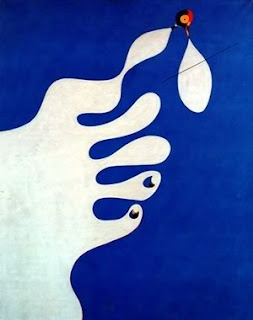
Borrowed from the library of Instituto Cervantes the MoMA catalogue of its 1993 Miró show. The catalogue essay Peinture-Poésie, Its Logic and Logistics by the show curator Carolyn Lanchner gives an interesting overview of Miró's oeuvre. What Picasso said to the young Spanish pretender became the opening of a new poem. I quoted, and, in a few cases, modified, titles of Miró's paintings for the rest of the poem. Miró loved poetry, and gave his paintings poetic titles. To my mind, it is somehow apt to incorporate and orchestrate his painting titles into a poem. Mira, Miro La Guitarra advised the Catalan peasant, pretend you’re waiting for the subway; you have to get in line. Wait your turn, after all. Painting. A bird eyes the hunter in a pinkish Catalan landscape. Person throws a stone at a bird. Painting. Hand catching a bird. A white bird floats above the carnival of harlequins. Painting. A yellow bird orchestrates a Dutch interior (I). (II)....

Joan Mitchell: Les Bluets 1973

Image
Discovered Joan Mitchell's art in the Feb issue of Poetry . She was the leading painter of the second generation of Abstract Expressionists. Poetry has a bunch of people write about her work and person. The most interesting is the piece by Marjorie Perloff, who saw the figuration in the abstract-looking work Meditations in an Emergency ca. 1967. Les Bluets 1973, in Center Pompidou, is utterly gorgeous.

Matisse: In Search of True Painting

Image
I have not seen the show yet, but bought the beautifully produced catalogue at the Met. All the essays examine the show's focus: Matisse's work in pairs, trios or series. Landscapes, still life, interiors, nudes--these genres at the heart of Matisse's painting--saw intense experimentation in the re-working of an original. What is striking about Matisse's pairs is that they were very often painted in the same format and size. These were very controlled experiments. More radically, they were also shown by Matisse as finished paintings in their own right. The sketch was traditionally hidden from sight but not Matisse's. Later in his career, he showed, together with the painting, the photographs that documented the progress of the painting. He was responding to the charge of easy conservatism. He insisted that he was a painstaking artist who was constantly pushing the boundaries of his art. Of Interior in Yellow and Blue (1946) and Interior in Venetian Red (1946...

The ART of Modeling

Image
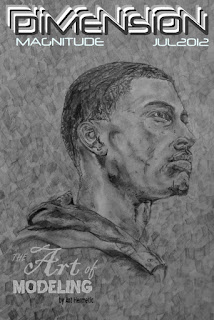
My very good friend Andrew Howdle, who works from Leeds, UK, has a beautiful portfolio of photographs and drawings out at Dimension Magazine . Titled cannily "The ART of Modeling," the work is as much about seeing the model Arnold Aziza as showing him off. "Arrival," a professional-looking fashion shot, reminds us of the various meanings of the key word in the title: "Model (N) a new system of seeing (1593); an exemplar (1693); a person drawn by an artist (1873); (V) to wear clothes for a fashion display (1904). The work looks better than much of what GH and I saw in Chelsea during our gallery hop yesterday. Alexander and Bonin showed the "Airmail Paintings" of Eugenio Dittborn, a Chilean artist. According to the press release, the collages on lightweight fabrics that could be folded and mailed to friends circumvented the constraints of working under Pinochet's dictatorship. The format was formally and politically resonant but the collages t...

Poem: "You Ask Me If You Could Paint Me"

You Ask Me If You Could Paint Me here comes another, this one with a brush instead of a book, or rope, or whip             Dilruba Ahmed, “The Other Side (on Gauguin)” If you will paint me, paint with the good book. Its leather smelling of tanneries and smeared crimson makes a lifelike print. The sermon on the mount may tattoo in blue the blessed head. Paint also with a rope, rub it across the hands that all may see my long self-restraint and guess my release. Then nail the hemp to the canvas, top right corner, to outface me with its reality. With your brush, whip my torso into flesh. The violence without must be met by violence within. Strike! Harder! Let my body writhe, a commotion contained in the cool and hard figure of a pear. for Valerie

"Revolution! The Atlantic World Reborn"

Last Sunday GH and I went to the New York Historical Society to look at a few of its current exhibitions. "Harlem," a show of photographs by Camilo José Vergara, was only of passing interest.  "Hudson River School Highlights" was a small show of Romantic landscapes mainly by Asher B. Durand. We also saw "Urban Views: American Cities 1717-1986." That show concluded with a photo-montage of Canal Street, New York City, by architect and photographer Claude Samton. GH who lived in the neighborhood in the 1980's was very happy to see restored his memories of various stores selling art supplies, metal scrap and rubber tires. After he left, I took in the wonderful show "Revolution! The Atlantic World Reborn." From the Society's website: Revolution! The Atlantic World Reborn is the first exhibition to relate the American, French and Haitian revolutions as a single, global narrative. Spanning decades of enormous political and cultural changes...

Junction/Cycle

GH and I wanted to see Richard Serra's new works at the Gagosian Gallery, and so took in other galleries on a pleasant, if drizzly, Saturday afternoon. At the Magnanmetz Gallery, Colombian artist Miler Lagos built an igloo out of books from a defunct US Navy base library. The old index cards papered a nearby corner. On the other end of the gallery, his video Water House  (2011) showed a water tank floating on water. It keeps water out instead of water in, and so becomes a kind of ark. At George Billis, American artist Adam Normandin showed photorealistic paintings of freight trains. I like the idea of reproducing spray-painted graffiti on uneven metal sidings with oil paint on a flat canvas. Affirmation was particularly compelling an image. Another artist, British Paul Winstanley, at Mitchell-Innes & Nash, painted from photographs, mostly his own. Showing people alone in public spaces, the soft-focused works seemed to meditate on people meditating in a moment snatched from t...

The Cone Collection at the Jewish Museum, NY

Last Wednesday LW and I saw at the Jewish Museum the special exhibition, "Collecting Matisse and Modern Masters: The Cone Sisters of Baltimore." Miss Etta and Dr. Claribel, as their friends called them, were introduced by their fellow Jewish Baltimoreans Leo and Gertrude Stein to Matisse in Paris. Like the Steins, they were avid collectors, financed first by their father's wholesale grocery business, and then by their brothers' hugely successful textile enterprise. Trained as a gynaecologist, Claribel became the Professor of Pathology at Baltimore Women's Medical College, and taught in both America and Europe. LW remarked on the near-invisibility of such accomplished women in the history of the USA held in most people's heads. Etta, six years younger, ran her father's household. She had a strong romantic attachment to Gertrude Stein. Both sisters remained unmarried to the end of their lives. I enjoyed the exhibition mostly for the Matisse paintings and s...

Emptiness, Variety and Power

TLS October 1 2010 from Katherine Wharton's review of Buddhist Warfare , edited by Michael K. Jerryson and Mark Juergensmeyer: Violent purges and insurgencies have occurred in all eras, with or without religious incitement. Yet there is something uniquely chilling about religious texts that justify or even aim to cultivate murder. For instance, the seventeenth-century Zen Master Takuan writes as follows: The uplifted sword has no will of its own, it is all of emptiness. It is like a flash of lightning. The man who is about to be struck down is also of emptiness, and so is the one who wields the sword. None of them are possessed of a mind that has any substantiality. As each of them is of emptiness and has no "mind", the striking man is not a man, the sword in his hands is not a sword and the "I" who is about to be struck down is like the splitting of the spring breeze in a flash of lightning. This is an application of the central Buddhist teaching of no-...

Gustave Caillebotte at the Brooklyn Museum

On Target First Saturdays, admission to the Brooklyn Museum is free. JS suggested seeing the Caillebottee exhibition "Impressionist Paintings from Paris to the Sea." He was there with two friends, R and Y, when I finally arrived after an epic journey on the 2-turned-local train.  Though "The Floor Scrapers" (1876) is a lesser painting compared to the one on the same theme in the Musee D'Orsay, it is still very pleasingly virtuosic and humanly sensitive. While the master works to finish a newly laid hardwood floor by shaving the buckling boards in place, his apprenticeship is, appropriately, sharpening his blade. Since the room is likely to be Caillebotte's studio, the painting becomes a depiction too of the relationship between tradition and the individual talent.  The best group of paintings are scenes on water. "Oarsman in a Top Hat" (1877-78) directs the eye along a wonderful recession into the painting, while "Oarsmen Rowing on the Yerres...

Bonnard's Late Interiors at Met Museum

The exhibition tries to put the case for Bonnard as a modernist master, and not a mere Post-Impressionist working past the due date of the movement. Restricting the show to his late interiors, however, does not help to make the case. The color experiments look interesting, but not innovative; his pictorial language changed little in these paintings from 1927 to the end of his life in 1947.  He painted the dining room, the breakfast room, the upstairs bedroom in his house at La Cannet, and the objects in them like a raffia basket of fruits, a vase of flowers, bottles of wine. The one still life that really held my attention was that of a bowl of cherries. And "The Breakfast Room" is noble. But I remember being bowled over by his paintings of the terrace and garden seen elsewhere. At this show I was underwhelmed.  I don't understand why one critic called Bonnard "the most abstract of painters." These late interiors seem to me insufficiently abstract. They are conc...

Human Meat, History Books

TLS December 5 2008 from Alan Jenkins' review of Francis Bacon at Tate Britain: Yet, as John Russell pointed out nearly thirty years ago, "perhaps the most persistent of Bacon's preoccupations is the problem of what a man is to do when he is alone in a room" . . . * Bacon would sometimes, to achieve the desired "thickness", model his single figure on a sequence of photographs from Eadweard Muybridge's The Human Body in Motion that showed two men wrestling--though at a glance, they could be having sex. . . . Then, once he had begun to show two or more people, the coupling--as in those earlier exceptions--becomes explicit. * In her catalogue essay Victoria Walsh cites Foundations of Modern Art by Amédée Ozenfant (1931) as having perhaps fertilized the insatiably curious young painter's imagination in ways that would lie dormant for years: "The search for intensity dominates the whole of modern painting. There can be no intensity without simplifi...