Posts

Showing posts with the label Beethoven

More Apollo Than Dionysus
Image
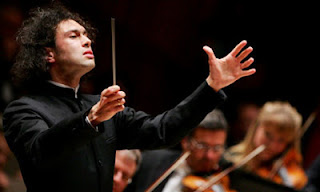
I heard the London Philharmonic Orchestra, under the baton of Vladimir Jurowski, twice last week. On Sunday, Vadim Repin was the spell-binding soloist in Shostakovich's Violin Concerto No. 1 in A minor. The performance of Beethoven's Symphony No. 5 after the intermission was intelligent and nuanced, more Apollo than Dionysus. Then on Monday H élène Grimaud performed a highly individualistic performance of Beethoven's Piano Concerto No. 4. The first movement was more frilly than strong. The second slow movement made up for the first. It sounded the depths, I thought. In the last movement, she seemed to be fighting against the music instead of playing it. It was a remarkable display of a fine musician imposing her will on a mighty music. I heard the Concerto in a way that I had never heard before, but was it Beethoven?  I did not care for Mahler's Symphony No. 5 performed after the intermission. The orchestral effort was heroic: the five movements added up to 72 ...

Viviane Hagner plays Vieuxtemps

We heard our last Orpheus Chamber Orchestra concert last night, at Carnegie. The program had a hodge-podge feel to it: Franz Shreker's Scherzo for Strings, Beethoven's Romance No. 2 in F major for Violin and Orchestra, Henry Vieuxtemps's Violin Concerto No. 5 in A minor and Mozart's Symphony No. 40 in G minor. The new commission, Alex Mincek's Pendulum IX: "Machina/Humana," written in a modernist idiom and in homage to Monteverdi's L'Orfeo , amplified the discord. The highlight of the concert, the Munich-born Viviane Hagner playing Vieuxtemps, was a superb memory to set alongside that of Gil Shaham playing with the orchestra at our first concert. Hagner was not a flashy player; she was, instead, deeply absorbing and utterly compelling. So was the orchestra accompanying her with passionate attention. The performance was in sharp contrast with the blandly professional rendition of Beethoven's Romance No. 2. Neither soloist nor orchestra seemed ...

Three Chamber Concerts

Last Wed, GH and I heard in Avery Fisher Joshua Bell conduct the Academy of St. Martin in the Field as its new music director. The program was all Beethoven, beginning with the Coriolan overture, continuing with a thrilling performance of the violin concerto, and ending with the Fourth Symphony. The chamber orchestra played with clear precision and exciting dynamics under the baton of a violin. In the non-concerto works, Bell conducted from the seat of the first violinist. Then, with LW and AG, at Zankel Hall on Saturday, I heard Takács Quartet play Janacek's String Quartet No. 2 "Intimate Letters" (1928), Britten's String Quartet No. 3 Op, 94 (1975), and Ravel's String Quartet in F Major (1902-03). The quartet, originally made up of four Hungarian music students, and named after one of them, now resides at the University of Colorado. Two of its original members remain--Karoly Schranz (second violin) and Andras Fejer (cello)--but the newer members have been with...

Emerson Quartet Plays Mozart and Beethoven

WL and I heard the Emerson String Quartet play at Alice Tully two nights ago. The performance of Mozart's Adagio and Fugue in C Minor, K.546 (1788) and String Quartet in B-flat major, K.589 ("Prussian") (1790) was polished but not particularly compelling. WL said they sounded like a band accompanying Viennese waltzes. I agreed. I said they sounded like elevator music. The Alternate Finale to Beethoven's String Quartet in B-flat major, the final movement that he substituted for the original Grosse Fugue on the insistence of his publisher, was not much better. It was light and airy enough, like candy floss. Only the slightly manic tempo of the performance gave the music an edge. After the intermission was the main event, the full string quartet. The first four movements were still played in a rather uninspired fashion, the Presto performed at a very fast tempo. In the fifth, the Cavatina, however, there was a transformation. It was as if a completely different group o...

Contra Eliot

After hearing Stephen Dillane read "The Four Quartets" at the Clark Studio Theater last Friday, my longstanding love affair with the poem may be over. The still small voice of the poem that I had always heard in my head was suddenly and merely expressive in the mouth of the actor, expressive of a conservative religion, a contempt for other people and an authoritarian disposition that I knew were there, but had ignored as in the flush of love. I still admire the questing spirit in the poem--"Old men should be explorers"--and still respect the scrupulous scrutiny with which Eliot examines his life. Like Wagner's return to Christian symbolism in Parsifal , which caused Nietzsche to break with him, Eliot enters in "The Four Quartets" a dead end that no one else can follow, except his co-religionists. The contrast with Beethoven's late String Quartet in A minor, which supposedly inspired Eliot, could not have been vaster. Played feelingly by the Miro ...

Best Canadian Poets 2010

Tonight I heard the Best Canadian poets (from the annual anthology, now in its third installment) read at St. John the Divine Cathedral. I had forgotten that the cathedral, in this case, one of its chapels, which made no difference, echoes too much to hear a reader well. Molly Peacock, the current poet-in-residence at St John, a dual citizen of both the USA and Canada and the Best series editor, introduced the poets. In her remarks, she proposed a tentative distinction between American and Canadian poetry. The former cannot assume that its audience will stay to hear it, and so has to grab their attention from the get-go, whereas the latter assumes in a friendly fashion that the audience will go along with it for a walk. Then she read a poem from the anthology to illustrate her point. The poem, about an interview that Billy Collins gave in Canada, made gentle fun of the ex-American poet laureate's prescriptions for writing poems. It was certainly a friendly, likable poem, which re...

Phil Grabsky's "In Search of Beethoven"

A feature-length documentary on Ludwig van Beethoven, with rather more biography than music commentary, more panegyric than analysis.  Van , which means the family came originally from Belgium, and not the aristocratic von.  The son and grandson of court musicians, Beethoven was constantly wooing noblewomen who could not or would not marry beneath them. Although reputed to be a misanthrope in his later deaf years, he could also be generous, giving an English visitor a ten-bar composition, which was only discovered in Cornwall in the 1980's. I was surprised to learn that he prayed twice a day, according to the testimony of his nephew, to a God not of the established Church, but of his own interpretation. I would have loved to be at the 1808 concert that he gave, entirely of his own music. The documentary mentioned only the Fourth Piano Concerto and the Fifth and Sixth Symphonies, but this blog gives the entire program for that cold Vienna night. It included the Gloria and Sa...

The Boy's Magic Horn

With LW, I heard Sir Colin Davis conduct the New York Philharmonic on Tuesday. The performance of Beethoven's Symphony No. 2 in D major was suave. I found it boring. Much more interesting were Mahler's Twelve Songs from Des Knaben Wunderhorn (The Boy's Magic Horn). Compiled and published by Clemens Brentano and Achim von Arnim, the book pretended to be a collection of authentic folk poems, but comprised free renderings of texts and original compositions of the authors. Mahler put to music "The Sentinel's Nightsong," the tongue-in-cheek "St. Anthony of Padua's Sermon to the Fishes," the pathetic "The Earthly Life," "Solace in Misfortune," the heroic and sweet "Song of the Persecuted in the Tower," the spring-like "Who Thought Up This Little Song?" the tragic "Reveille," the charming "Little Rhine Legend," the satirical "Praise from an Advanced Intellect," the insulting "...

John Singer Sargent Painting the Town

The Chinatown bus took only four hours to pull into South Station. It was easy getting to Hotel 140, on Clarendon Street, by subway. When SK arrived, from Montreal, we walked a couple of blocks to Copley Square. We ate a simple lunch and dipped our legs into the fountain. SK is a now a proud homeowner, with his partner, in Paris. We both liked the Boston Public Library's McKim Building very much. Built at the end of the nineteenth century. it was a library in a palace. The entrance hall had a vaulted ceiling, on which were lettered the names of thirty famous Bostonians. A deep triumphal arch connected the entrance hall to the main staircase. The steps were made of ivory gray Echaillon marble, mottled with fossil shells. The walls were a warm yellow Siena. From the landing, through a big window, the courtyard and pool could be taken in. In the Sargent gallery, the American painter decorated its walls with the mural sequence Triumph of Religion . Many of the murals featured beaut...

So Soft and So Masterful

The first of two ghazals accepted by qarrtsiluni is now up on their website . The theme for the issue is New Classics. You can download the podcast of me reading the poem. * Heard with LW last night Kurt Masur conducting the New York Philharmonic. The performance of Beethoven's Symphony No. 1 was crisp and unified. It gave off the impression of great mastery, on the part of both composer and conductor. It was the first time I heard Number 1 live. I was too tired to pay close attention to Bruckner's Symphony No. 7, which followed after the intermission. Lots of swirling passages but I could not make sense of it in my sleepy state. The program notes tell me that Bruckner was a late bloomer. He composed the first of his nine symphonies in 1865-66, when he was 41.

Riccardo Muti conducts Honegger and Beethoven

Last night, with LW, I heard Arthur Honegger (1892-1955) for the first time, played by the New York Philharmonic. A native of Switzerland, he studied at the Paris Conservatory and banded with fellow students--Darius Milhaud, Francis Poulenc, Georges Auric, Germaine Tailleferre, and Louis Durey, with Eric Satie as spiritual godfather--to become known as Les Six. Symphony No. 2 (1941), played by a string orchestra and a lone trumpet. was composed during the Nazi occupation of France, which Honegger refused to leave though he could claim neutrality as a Swiss. The symphony is in three movements. The trumpet comes in at the very end to support the strings in a chorale-like finish. An economy of means, fitting, perhaps, to a wartime symphony. I always fear disappointment when going to a performance of Beethoven's symphonies. Karajan and the Berlin Philharmonic are in my head, and no performance will, of course, sound like them. I thought Muti gave an uneven interpretation of the Eroic...

Alex Ross on Leonard Bernstein

The New Yorker , December 15, 2008 Of Bernstein conducting Mahler's Second Symphony, the "Resurrection," Ross writes: At the climax of the first movement, the brass unleash militant chords that turn fearsomely dissonant, while a scale grinds downward in the remainder of the orchestra. The sequence ends with a violently plunging octave figure. I remember Bernstein flinging down his arms to produce it. On the recording, you can hear the echo sail down the nave of the cathedral, like a hammer thrown with enormous force. The moment exemplifies Bernstein's ability to render almost any abstract sequence of notes or chords as a physical act, a sweatily human gesture. . . .  The American gesture. American Expressionism. Abstraction as a physical act, a "sweatily human gesture." * Of Bernstein's democratic taste and global syntax: In childhood, Bernstein was an omnivorous consumer of music, blissfully unaware of the distinctions between high and low, elite and po...

To Live Aesthetically Or To Live Ethically

from "Why So Serious?" Alex Ross's review (TNY Sep 8, 2008) of Kenneth Hamilton's After the Golden Age: Romantic Pianism and Modern Performance , and William Weber's The Great Transformation of Musical Taste" Concert Programming from Haydn to Brahms : With the aristocracy declining in the wake of the French Revolution and subsequent upheavals, the bourgeoisie increasingly took control of musical life, imposing a new conception of how concerts should unfold: programs favored composers of the past over those of the present, popular fare was banished, progrm notes provided orientation to the uninitiated, and the practice of milling about, talking, and applauding during the music subsided. To some extent, these changes can be explained in anthropological terms: by applauding here and not applauding there, the bourgeois were signalling their membership in a social and culturel elite. As Johnson points out, they felt obliged to reconfirm that status from year to ye...

TLS November 30 2007

from Gabriel Josipovici's Commentary piece on Modernism "Fail again. Fail better": Why is it that a composer such as Haydn could write a hundred symphonies and only a few years later Beethoven, no less industrious a composer, could only write nine? Quite simply because Haydn did not feel he had to start from scratch. What he had to do was fill a form, a mould. . . . Unfortunately, after Beethoven, . . . composers were left with nothing to hold on to except their individuality, and without Beethoven's dynamism and optimism, this gradually led, in the course of the nineteenth century, to an art less and less time-driven, more and more prone to stasis, dreaminess and disintegration. The composer at the start of the twentieth century, an Adrian Leverkuhn or an Arnold Schoenberg, was thus caught btween repeating forms he could no longer believe in and trusting a subjectivity which was growing daily more problematic. * Genres were the sign of submission to the authority of ...