Posts

Showing posts with the label Pang Alvin

Singapore Launch of Steep Tea and SWF
Image
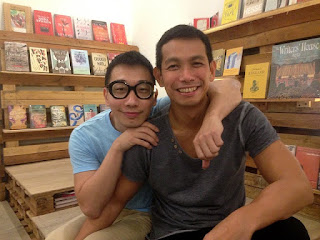
Thanks very much, everyone who came out to the Singapore launch of Steep Tea tonight. You were, in a word, overwhelming. Your support, love, and friendship. I am so grateful. I'm just sorry that there wasn't time to talk to everyone properly. I hope we will see one another when I visit again next summer. If you fancy hearing me talk cock sing song about "Raising the Profile of Asian Literature" (10 am) and "Getting Published Overseas" (2:30 pm), come to the Singapore Writers Festival at The Arts House tomorrow (Sat). For those of you who couldn't get a copy of my book tonight, it will be available at the festival bookshop at The Arts House from tomorrow to the end of the festival. Thanks again, Boedi Widjaja, for the cover image and for coming out tonight. Thank you, Anthony Koh Waugh, for hosting the launch at your wonderful bookstore. You are a sweetheart. At the Singapore Writers Festival, I was a panelist in two...

Union

Image
Last Sunday, the NY launch of UNION, an anthology that celebrates 50 years of Singaporean writing and 15 years of seminal American journal Drunken Boat . I read from The Pillow Book at Singapore: Inside Out, with Alvin Pang (editor), Ravi Shankar (editor), Sharon Dolin and Amanda Lee Koe. Photos by GH.

Union and Haiku

Four poems in the Union folio of Singaporean and American poetry, published by Drunken Boat. Thanks, Ravi Shankar and Alvin Pang. Good reading for the weekend! * Minneapolis haiku morning headache— the insistence of birds in loring park

Speakeasy #14 Gwee Li Sui and Koh Jee Leong

Image
Read with Gwee at Speakeasy #14 organized by Pooja Nansi at Artistry Cafe last night. Video taken by Alvin Pang.

SLF in The Straits Times

Image

Missing Subject Line

Wrote a poem to thank Elsa for her Christmas present of Arthur Yap's Complete Poems. The poem "Missing Subject Line" is now published as part of a Singaporean collaboration with Prairie Schooner in the latter's Fusion series . Thanks, Alvin Pang, for editing the Singapore selection. Thanks, Kwame Dawes, for the brilliant idea behind Fusion.

Yeng Pway Ngon's Poems of Rebellion

I must confess that I don't know any Singapore poetry written in languages other than English. Alvin Pang and Goh Beng Choo perform a signal service for me and others like me by translating Yeng Pway Ngon, an important poet who writes in Chinese. Born in 1947, Yeng has written not only poetry, but also essays, fiction, plays and literary criticism, 24 volumes so far. He was the editor and publisher of two literary magazines, Teahouse in the 1980s and Encounter in the 1990s. He has had a long and distinguished literary career. In 2003 he received Singapore's Cultural Medallion for Literature. The pamphlet I bought from Books Actually last summer offers a selection of his early poems, published between 1967 and 1970. It is intended to be the first part of a series of translations of Yeng's poetry. Titled Poems 1 [Rebellion] , the work is very much that of a young man, as he agonizes over his place in the world and lashes out at careerism and consumerism. Steeped in the ...

3 Poems in Axon

All three poems have epigraphs from Lee Tzu Pheng. Alvin Pang was the Consulting Editor for this issue of the Australian journal Axon . 

Two Readings in Singapore

Image
This was the longest time that I have ever spent in Singapore since leaving it. I will probably come back to this month from time to time, but I just want to remember, for now, the two readings I did there. Paul Tan from the National Arts Council referred me to Paul Rozario at The Arts House. Paul R. was extremely friendly and helpful in setting up the reading, which took place on August 4, in the former Ministers' Lounge in the old Parliament House. William Phuan, the director of The Arts House, was present throughout the evening too. Photo by Lianguo I was surprised and glad to see Robert Yeo in the audience. I have known his poetry since secondary school, but had never met him properly. It was fun to go out afterwards with him and Alvin Pang, who kindly agreed to moderate the Q&A, for supper at Adams Road Hawker Center. I was especially pleased to see a number of ex-students from Chua Chu Kang Secondary School turning up. They must have learned from Facebook and els...

"The New Poetry of Singapore" by Gwee Li Sui

The essay appears in Volume II of Sharing Borders: Studies in Contemporary Singaporean-Malaysia Literature , itself a part of the series Writing Asia: The Literatures in Englishes . In the essay, instead of rehashing the tired discourse of nationalism in the poetry of earlier Singaporean poets, Gwee focuses on younger poets who published their first books in 1997 and later. Relatively free from the control of both State and University, these poets put out, with the help of independent publishers, a series of works that have re-energized Singaporean writing. A chronology: 1997 - Alvin Pang's Testing the Silence , Aaron Lee's A Visitation of Sunlight , and Yong Shu Hoong's Isaac . 1998 - Grace Chia's Womango , Alfian Sa'at's One Fierce Hour , Felix Cheong's Temptation and Other Poems , Damien Sin's Saints, Sinners and Singaporeans and Gwee's Who Wants to Buy a Book of Poems? 1999 - Felix Cheong's I Watch the Stars Go Out , Daren Shiau's ...

Gwee Li Sui's article "The Road People"

Li Sui was kind enough to send his Asiatic article to the poets he cited in it. The long scholarly discussion analyzes the relationship between some Singaporean poems and that country's restless urban flux, represented by the constant dilemma of roads. Having just motored from Santa Cruz back to San Francisco last night, I was especially taken by the contrast Li Sui alludes to between postmodernist visions of infinite roads, and Singapore's anxiety-ridden views of limits. Poems by Lee Tzu Pheng, Boey Kim Cheng, Paul Tan, Felix Cheong, Alvin Pang and Aaron Lee predict, lament, visualize, and compose those limits. One of my early poems, "Going Home from Church on Bus 197," included in  No Other City: the  Ethos Anthology of Urban Poetry  (2000), is part of Gwee's discussion. Asiatic , a journal of English Language and Literature published by the International Islamic University of Malaysia, is worth looking into for itself. It publishes not only scholarly art...