Posts

Showing posts with the label Spain

Things about Costa de Barcelona I Will Not Forget

Things about Costa de Barcelona I Will Not Forget  Not the taste of paella marinera but the taste of anticipation. Anchovies. Beach that smells of cigarette ash. Men, like so many beaten up luxury boats, cruising in the lap of the Mediterranean. The water is so clear off Platja des Cavallet that I see the ghost of the fish that I ate last night. Eight years ago, you treaded the narrow walkway around the construction scaffolding inside the Sagrada Familia. Now the nave is polished to a shine, the light streaming through the stained glass windows as if through water. It’s all too bright and clean to you. When the church is finished in ten years’ time, it will be just another church, Gaudi dead as a saint in the basement. What chance! Meeting B and J on the train to Sitges. I first met them in Madrid a month ago, when we were standing still. Lying in an enormous bed with our new friends, in a restaurant overlooking the sea, we drank too much. Nothing happened, but a morning ...

Steep Tea in Desperate Literature

Image
Guy visited Desperate Literature Bookshop, where I read from my book STEEP TEA. He took these photos. When you are in Madrid, be sure to visit this lovely bookshop and get a copy of STEEP TEA from Madrid! We're leaving for Barcelona tomorrow morning.

Things about Andalusia I Will Not Forget

Things about Andalusia I Will Not Forget  So many palm trees, shooting up like fireworks. A courtyard of orange trees. After harvest, the sunflower stalks stand alert as otters. The Alhambra is a mosaic of not two, not three, but four dimensions. After moving through its fountains, gardens, and palaces, I see on the way home the tessellation of leaves and the space between leaves. I see the tessellation of leaves and the time between leaves. Riding pillion behind my host on a motorbike and slipping through the streets of Sevilla. In Murillo’s great painting, the child gives his coin to his mother, with a look of tenderness that only a child can give, just as the towering saint gives his money to the beggar man. Outside the cathedral, one night, the guitarist waved away the coin proffered by a child. He did not want charity but to sell his compact discs. Mecca is east-southeast but the Mosque of Córdoba faces south because its royal builder was homesick for Damascus. Repre...

Los Gallos

At the Plaza de Santa Cruz, I watched the Los Gallos (The Cocks) tablao flamenco last night. Great singers and guitarists. The male dancer was terrific, as was one of three female dancers. The oldest one, of course. Loud as castanets the dancer snaps her fingers— fish, fowl, and flesh

Things about Madrid I Will Not Forget

Things about Madrid I Will Not Forget  So many sex workers. South of Gran Via, the women are mostly white, north they are mostly dark, or trans. A melon is called melón but a watermelon is called sandia. In the morning, when the day is fresh, I love running shirtless along Gran Via and all around Retiro Park. Given the wrong drink and too shy to ask the muscle waiter to change it. Tinto de verano, con limón. In a plaza chanced upon one night, Chinese schoolchildren kicking around a football and speaking Spanish, of course. Which of them will be the next David Villa? Which the next Lorca? Who will come first? Woken up at 4 am by the cigarette-edged talk of kids outside the club opposite my apartment. The dark pearl on the outside of razor clams. A cruise club called Organic, equipped with a cross, resting horizontally, and revolving, on one leg. Goya’s Black Paintings. ¿De donde eres? The same younger Asian with the older white man sighted in Buenos Aires, London, Paris, and...

Segovia and Haiku

Visited Segovia yesterday, just half an hour by train from Madrid. When the bus from the train station approached the old city, everyone was immediately struck by the grand Roman aqueduct running across the public square. The aqueduct also ran underground to the castle. At the museum of contemporary arts, I saw the show of Esteban Vicente's works. Born in Turégano, Spain, he studied art in Madrid, remarking on his experience at the Academy: "It doesn't give you any ideas about anything. It gives you tools, and teaches you about materials. Academic training is safe. It prepares you to be against." He moved with his American wife to the USA a few months after the outbreak of the Spanish Civil War. One of the first generation of American Expressionists, he knew artists such as De Kooning, Pollock, and Rothko. His works in the Segovia museum were constantly evolving, but maintained a delicate sense of balance. I liked his drawings best: their austerity was sensual and s...

Flamenco en viva

Had a dinner of grilled octopus and pickled pork skewers last night at Casa Patas before watching the flamenco show. Raquela Ortega the dancer was mesmerizing. She showed why duende could only manifest at a mature age, when the artist brought all her life and training to the performance of a moment. The male dancer Sergio Aranda was virtuosic in his technique but he looked too young to be dancing with Ortega. The three singers, Tomasa Gabriel, Jesule Utrera, Fernandez de Antonio, were very good, as was the guitarist, the very handsome Yeray Cortés.

Haiku

Taking my heart to the Sunday flea market— what will it fetch? Taking my heart to the Sunday flea market south of La Latina Taking my heart to the Sunday flea market instead of the post office

Diary

Yesterday's highlights both involved eating. Lunch at a local chorizo restaurant with James Womack​ and Terry Andrew Craven​. James is a poet, translator, and publisher, originally from Cambridge, UK, now based in Madrid. Terry moved from Leeds to work with Shakespeare and Company in Paris before taking over the cave of treasures called Desperate Literature​ Bookshop with his wife Charlotte four months ago. Wonderfully easy conversation. Among other things, we talked about how different cultures invite people home, or not. And the arms race of giving birthday presents to one's spouse. My sausage was delicious. The other highlight was dinner by myself at 11 pm. Out on a walk, I was enticed by the sight of so many people eating and drinking outdoors at that late hour to wander into Plaza Juan Pujol, where I sat and had a good risotto, washed down with chilled red wine. The restaurant was aptly named El Balcón de Malasaña. I perched on that balcony and watched the world enjoy them...

Diary and Haiku

After looking at Guernica , the crowd at my elbows, their tour guide in my ears, I am coming out against history painting. The magniloquence of terror. The demand for submission. Far more delightful is the magic of Joan Miró, whose rooster crows in a landscape with it in it. On the balcony carrying a bowl of cereal cock-a-doodle-do

Diary

Image
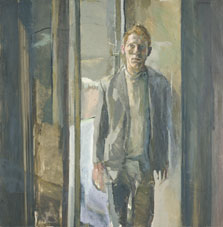
Yesterday's highlight was a visit to Museo Thyssen-Bornemisza. Was surprised to see a number of Lucian Freuds, including his Retrato of the Baron himself. Really liked Michael Andrews's "Portrait of Timothy Behrens," which shows the young man standing pensively at the entrance to the bathroom. An unusual view of Saint Sebastian, tended by Saint Irene and her maid, attributed to Dirck Jaspersz. van Baburen: Had lunch at La Cueva, with all male patrons, including construction workers from a nearby site. Used la lavadora successfully. Napped. Went for an walk at nine, when it was cool, and discovered the lively night life of Chueca and its surrounds. Lots of restaurants, outdoors and in. Sex workers plied their trade at street corners, a few transvestites. Men clustered in sociable groups along Calle Pelayo, the gay drag. NT and his course mates were in the apartment when I returned. I joined in their discussion about the existence of god. Since it was past...

Prado and Haiku

Yesterday was my first full day in Madrid. Woke up at my usual time and worked on the Mothership interview. The gym on my street, Calle Valverde, opened at 9 am. A cute young gay guy was working out there when I arrived. Four other guys came in after me. The equipment was rather worn, but I managed to put in a good workout. Then I went for a run. I had walked around Chuecas on the day of my arrival in Madrid. Yesterday, I ran to the west of my street, and looked around Malasaña. The neighborhood, with its alternative shops and wall posters, reminded me of the Lower East Side. Like the LES, it was also gentrifying, art galleries and such. I decided to walk to the Prado instead of taking the Metro. At the museum, I saw Titian's wonderful "A Knight of Malta with a Clock." Everywhere I was looking for portraits of men in their handsome prime, Caravaggio's young "David with the Head of Goliath" proving an exception. Velazquez was a star of the show. His "L...

Twelve Poets on the Left

TLS May 30 2008 from H. R. Woudhuysen's "Bound to please": For Larkin, two sorts of books needed to be readily accessible: "Within reach of my working chair I have reference books on the right, and twelve poets on the left". No doubt some of his poets (who included Barnes, Praed, Whitman and Frost) could be found at the Fair in early or interesting editions. I first read "reference books" as Work, and "poets" as Pleasure, but realized they were Work and Work, since Larkin reaches for them from his working chair, and refers to them as if they were his hands. So, my twelve hardworking poets--in other words, huge quarries for my work--are: 1. Shakespeare 2. Milton 3. Pope 4. Keats 5. Whitman 6. Stevens 7. Yeats 8. Eliot 9. Moore 10. Auden 11. Larkin 12. Heaney *** from Zinovy Zinik's Commentary piece "Dinner party test": A major poet can be both a politician and a hermit, but major poetry is unthinkable without a major readership. ...

TLS March 28 2008

From Christopher Reid's review of Modern Painters: The Camden Town Group at the Tate Britain: The more likely truth is that Sickert was simply the first painter in a long tradition to point out that the reclining nude, a standard compositional trope, had a lot in common with the inertia of a corpse, and the scrutiny of the artist with the calculating gaze of the malefactor. *** From Fernando Cervantes' review of Marjorie Trusted's The Arts of Spain: Iberia and Latin America 1450-1700 : In the 1920s, Jose Ortega y Gasset attempted to counter these myths with the argument that Europe was not the creation of the sovereign nation state but, rather, the result of a piecemeal and laborious cultural fusion of what he called the "Germanic" and the "Mediterranean" elements. What particularly interested Ortega was that this fusion had been attained Iberia earlier and more permanently than in any other part of Europe, so that the presence of those very elements th...