Posts

Showing posts with the label Mahler Gustav

More Apollo Than Dionysus
Image
I heard the London Philharmonic Orchestra, under the baton of Vladimir Jurowski, twice last week. On Sunday, Vadim Repin was the spell-binding soloist in Shostakovich's Violin Concerto No. 1 in A minor. The performance of Beethoven's Symphony No. 5 after the intermission was intelligent and nuanced, more Apollo than Dionysus. Then on Monday H élène Grimaud performed a highly individualistic performance of Beethoven's Piano Concerto No. 4. The first movement was more frilly than strong. The second slow movement made up for the first. It sounded the depths, I thought. In the last movement, she seemed to be fighting against the music instead of playing it. It was a remarkable display of a fine musician imposing her will on a mighty music. I heard the Concerto in a way that I had never heard before, but was it Beethoven?  I did not care for Mahler's Symphony No. 5 performed after the intermission. The orchestral effort was heroic: the five movements added up to 72 ...

The Boy's Magic Horn

With LW, I heard Sir Colin Davis conduct the New York Philharmonic on Tuesday. The performance of Beethoven's Symphony No. 2 in D major was suave. I found it boring. Much more interesting were Mahler's Twelve Songs from Des Knaben Wunderhorn (The Boy's Magic Horn). Compiled and published by Clemens Brentano and Achim von Arnim, the book pretended to be a collection of authentic folk poems, but comprised free renderings of texts and original compositions of the authors. Mahler put to music "The Sentinel's Nightsong," the tongue-in-cheek "St. Anthony of Padua's Sermon to the Fishes," the pathetic "The Earthly Life," "Solace in Misfortune," the heroic and sweet "Song of the Persecuted in the Tower," the spring-like "Who Thought Up This Little Song?" the tragic "Reveille," the charming "Little Rhine Legend," the satirical "Praise from an Advanced Intellect," the insulting "...

Gustavo Dudamel conducts Mahler's Fifth

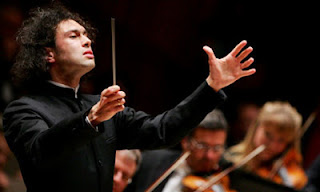
The young Argentinian conductor (he's turning 28 in two weeks) drew a committed performance from the orchestral players last night. The performance was impassioned yet cogent. The opening funeral-march movement was massive and moving. The slow movement, the famous Adagietto, shimmered with tenderness. A massive, multi-layered work, the symphony has five movements organized in three parts:  Part 1: Funeral March: With measured step. Strict. Like a Cortege xxxxxx Stormily. With greatest vehemence Part 2: Scherzo. Vigorously, not too fast. Part 3: Adagietto. Very slow xxxxxx Rondo-Finale. Allegro giocoso. Lively Though fiendishly complex, it seemed last night all of a piece from beginning to end, its unity that of a scale of emotions.  Before the Mahler, Pinchas Zukerman played Violin Concerto, Op. 30, written by Oliver Knussen (b. 1952) for him.