Posts

Showing posts with the label Translations

"Attribution" in Vietnamese

Image
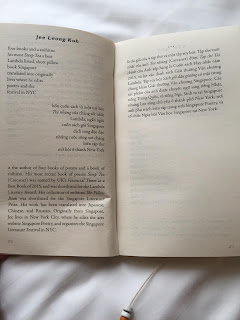
So pleased that my poem "Attribution" from STEEP TEA has been translated into Vietnamese and published by AJAR Press in ABRACADABRA, the publication of A-festival in Hanoi in August 2016. Thank you, Nha Thuyen, and congratulations on the successful inaugural festival!

Third Annual IAAC Literary Festival

On Gopika Jadeja's invitation, I attended the third IAAC Literary festival yesterday. The 3-day festival, organized by the Indo-American Arts Council, was attended mainly by South Asian Americans. It was a fascinating glimpse into the relationship between them and Indians from India. The Americans were intensely interested in social and political developments in India. They were also captivated by celebrity culture, that of Bollywood and of nationalist politics. The panels on the the first biography of film legend Shashi Kapoor and on the secret diary of Kasturba Gandhi were very well attended. I particularly enjoyed the panel "This Unquiet Land," also the title of the debut work of non-fiction by award-winning broadcast journalist Barkha Dutt. She has reported on a wide range of issues, famously on the disputed region of Kashmir. She was impressively sharp and articulate, and was well-matched by the nimble acuity of her interlocutor Suketu Mehta, the New York-based aut...

Translations and Haiku

"In His Other House" and "Singapore Buses Are Very Reliable" have been translated into Russian by Dmitry Kuzmin. I feel very honored. * What's holding up the clouds in the treeless sky?

Haiku and Vietnamese Attribution

Image
August evening an anonymous music review of a June night * Very pleased to have my poem "Attribution" (from STEEP TEA) translated into Vietnamese and published in the festival pamphlet of the A-Festival in Hanoi. Thank you, Nha Thuyen, for the translation/publication and for your love of poetry from different places and languages. I hope to join you in Hanoi some day. Title: ABRACADABRA (poetry collection of A-festival) First published by AJAR press, Hanoi, 2016. Language: Multi-languages: Vietnamese, English, Chinese, Thai, Tamil Product Dimensions: 12x 20.5 cm 168 pages ISBN 978-1536829075 And thanks, William Phuan, for the image.

Into Russian now. What next?

Russian poet, critic and publisher Dmitry Kuzmin has just translated my poem "To a Young Poet" into Russian . He has previously translated my poem "Brother" from the Best New Poets anthology. The Russian translation of "To a Young Poet" comes hot on the heels of the Latvian translation. This poem has legs! Thanks, Dmitry!

Into Latvian

My poem "To a Young Poet" has been translated into Latvian and published in Satori . Thank you, Atdzejojis Ilmārs Šlāpins! You can read the English version here .

Vicente L Rafael's Motherless Tongues

Thought-provoking essays on post-colonialism, neo-colonialism, translation, and the insurgency of language. Looking at the Philippines at the time of its Revolution, American occupation, and "People Power" II, and at the USA after 9/11, Rafael traces the attempts by colonial and neo-colonial powers to master translation in order to subjugate local populace. Each time he shows that the powers fail because of the insurgency of language, that which cannot be translated. Particularly interesting to me is the idea of the radical welcome that Revolution shows to the Other. Also fascinating is the failure of American schooling to eradicate Tagalog and other vernacular idioms and accents. The Introduction speaks eloquently of the suppression of other languages in order to speak and write in scholarly English. The final essays on Filipino scholars--Renato Rosaldo and Reynaldo Ileto--are appreciative of their achievements while remaining alert to their limitations. Of the latter's ...

Translations of an insignificant Japanese poet

For those of you who have been reading my haiku, I must now reveal that they are not my own works, but translations of Japanese originals. Six of these English translations have now been re-translated into Chinese by Zhou Decheng, and published in the Chinese-language Poetry Monthly . The story of my English translations is as follows: In February 2011, when I moved into my Upper West Side apartment, not far from 80 Riverside Drive, where Yone Noguchi boarded for a time, I found a sheaf of haiku in the bedroom closet, almost as if it had been left for me. To my surprise, the poet made numerous references to people and places that I knew from living in New York City. I was thus compelled to translate the poems from the Japanese. As I worked on these exhilarating, enigmatic pieces, I found myself searching out the street corner, the tree, and even the bird that had so enraptured our poet. In this manner I traced the route taken through Central Park—entering at 86th Street on the west ...

The Magical Art and Haiku

Last night WL and I attended the talk "The Magical Art of Translation: From Murakami to Japan's Latest Storytellers" at Japan Society. American translators Jay Rubin and Ted Goosen spoke about their personal encounters with Murakami. Motoyuki Shibata, the eminent translator of American literature into Japanese, gave the most interesting talk. He told the audience that Murakami wrote the earliest passage of his first novel in English, in order to try to get away from the decorum and burden of past literature. In this, he had a predecessor in a late nineteenth-century writer, who wrote the second part of his book in Russian, for the same reason. Aoko Matsuda, a young novelist, grew up with Murakami the classic at school. Satoshi Kitamura, a children's book illustrator based in London, showed slides of his very beautiful work, illustrations of poems by Emily Dickinson, Wallace Stevens, Charles Simic, Edgar Allen Poe, amongst others. I am very glad to discover Monkey Busi...

6 more days...

... to the October 1 deadline for papers for Translating Asia panel !  “A good translator is an exquisite ambassador,” writes poet and scholar Waqas Khwaja in his introduction to the 2010 anthology Modern Poetry of Pakistan . “Just as the creative artist suggests new ways of looking at the commonplace, the translator opens up to readers a whole new world, a whole new mode of perception and experience, they may hardly have suspected of existing.” The comparison with an ambassador suggests that a translator be conversant not only with the languages of composition and translation, but also with the different cultures. As Khwaja puts it, “How, despite what are seen as virtually insurmountable odds, can translation happen so that it does not undervalue, misrepresent, or (not an unknown phenomenon) utterly dispense with the original?” The panel aims to consider literature from South, East, and South-east Asia.

The Persian Book of Kings

Finally finished reading Shahnameh today, the Persian Book of Kings, translated by Dick Davis. Arranged like a royal chronicle, the book falls into two parts, the first legendary half, teeming with hero-kings and demons, and the second more "realistic" half, closer as the history is to Ferdowsi's own time. The turning point lies in the reign of Sekandar (Alexander the Great), who is depicted initially as a world conqueror, but later, more importantly, as a seeker of knowledge. I like the legends better. They have more colorful characters, and livelier adventures.The defeat of Zahhak the Demon King by Feraydun, the Simorgh (magical bird) that raised Sam and helped him in his distress, the riddles posed to Zal by Manuchehr's priests, the seven trials of Rostam, the duel between Rostam and his son Sohrab, which I first read as a poem by Matthew Arnold. The characters in the second half may be more complex, less easy to pin down, but the struggle between hero and king ...

"Ganymede Unfinished" Reviewed and "Asymptote" Launched

Gregory Woods reviews Ganymede Unfinished , edited by Bryan Borland as a tribute to the late John Stahle. ... It is an apt tribute to Stahle, serious and stylish; even if it is, perhaps, less selective than he might have been with some of its weaker material. The creative content gets off to a reassuringly solid start, with fine poems by Jee Leong Koh and Matthew Hittinger.... *** Yew Leong Lee launches a new journal dedicated to literary translations. Conceived in Singapore, but edited from different parts of the world, Asymptote  is now calling for submissions of translations of fiction, non-fiction, drama and poetry. From the website: Already in the lineup for our quarterly online magazine, slated for a Jan 2011 launch, are a despatch from Afghanistan, translated from the Farsi, about the plight of women in the context of the ongoing war, an essay from Japan by a noted mathematician cum essayist entitled “Literature and Mathematics”, a group of poems from Melih Cevdet And...

Translating and Writing Tankas

In teaching the tanka, Kimiko drew our attention to the niceties of translating Japanese poetry into English. From Sato 1999 Symposium on translating Asian languages (see Manoa 11/2): Finally, to state the obvious, syllabic value differs from language to language. Japanese is a polysyllabic, vowel-laden tongue; English isn't. English can express, on average, twenty to twenty-five percent more than Japanese can with the same number of syllables. You can guess what happens when the 5- and 7-syllable formations are applied in translating traditional tanka and haiku: the result usually says more than the original does. Well, does all this matter? After all, Japanese and English are so different. Because the languages are different, shouldn't the assumption be that forms can't be transferred? Japanese poets may regard tanka and haiku as one-line poems, but it's highly doubtful that they have any notion of the "line" in the Western sense and, anyhow, one-line po...

Pound and Parody

TLS October 30 2009 from Christopher Reid's review of Helen Carr's The Verse Revolutionaries: Ezra Pound, H. D. and the Imagists : . . . it does seem that, for Pound, authenticity of voice could only, or most reliably, be attained through translation or adaptation. Even those poems of his that might have come about solely as expositions of the pure Imagist manner--miniature masterpieces like "In a Station of the Metro" and "The Garden"--wear an air of pastiche, as if behind each of them lay some imagined original in a foreign tongue, most likely Japanese or French. Reid's comment on Pound as pastiche helped me understand an editor's comment on the ghazals I submitted. He said, "They read like the most exquisite parodies of Pound translations from Chinese and Japanese, yet they also do work as original poems do." The slipperiness of imitation, translation and parodies! I did not write the ghazals as parodies, exquisite or not, but now ...

Cien Sonetos de Amor: XVIII

I read Sonnet XVIII on the train, and fell in love with it straightaway. It sings of ancient mountains and quarrels. It shoots the arrows of beauty into the heart. My overly literal translation follows the original. I'm learning Spanish, and would be glad to get some tips. XVIII Por las montañas vas como viene la brisa o la corriente brusca que baja de la nieve o bien tu cabellera palpitante confirma los altos ornamentos del sol en la espersura. Toda la luz del Cáucaso cae sobre tu cuerpo como en una pequeña vasija interminable en que el agua se cambia de vestido y de canto a cada movimiento transparente del río. Por los montes el viejo camino de guerreros y abajo enfurecida brilla como una espada el agua entre murallas de manos minerales, hasta que tú recibes de los bosques de pronto el ramo o el relámpago de unas flores azules y la insólita flecha de un aroma salvaje. XVIII Through the mountains you move as the breeze moves, or the brisk stream falling from the snows, your fine h...

"Cien sonetos de amor": I

Pablo Neruda dedicated Cien sonetos de amor ( One Hundred Love Sonnets ) to his wife Matilde Urrutia, and in his dedication he wrote of how their life in the fishing village of Isla Negra (85 kilometers south of Valparaiso, Chile) inspired these sonnets: When I set this task for myself, I knew very well that down the right sides of sonnets, with elegant discriminating taste, poets of all times have arranged rhymes that sound like silver, or crystal, or cannonfire. But—with great humility—I made these sonnets out of wood; I gave them the sound of that opaque pure substance, and that is how they should reach your ears. Walking in forests or on beaches, along hidden lakes, in latitudes sprinkled with ashes, you and I have picked up pieces of pure bark, pieces of wood subject to the comings and goings of water and the weather. Out of such softened relics, then, with hatchet, and machete and pocketknife, I built up these lumber piles of love, and with fourteen boards each I built little ho...