Posts

Showing posts with the label Japan

50 States in 50 Days

Image
It's National Poetry Writing Month again, and I've started a project tentatively titled "50 States in 50 Days," as a way of getting to know this country better. Suggestions welcomed. Here's Day One: Alabama Why would you want to see a natural disaster, even if it’s the greatest? Visit the Vulcan instead, cast-iron god holding up his new spearhead to the sun. You can’t see the impact crater, even though the impact rim is intact. You can only walk in the maze of rings of fractured rock, more than 3 miles across, hope to find in the ground a splinter of shocked quartz, which proved this is indeed a star-wound. * PB invited GH and me to a sake tasting last night. Terada Honke has brewed sake for more than 340 years in Kozaki, in Chiba Prefecture, 87.5 km to the northeast of Tokyo. The lecture was by the 24th Head, Masaru Terada, who married into the family, like the two generations before him. The brewing house specializes in so-call...
Ruth Ozeki's "A Tale for the Time Being"

Utterly absorbing. The somewhat annoying voice of Nao Yasutani--an ethnic Japanese teenager raised in California and returned to Japan after her father lost his job in the dot.com crash--took a little time to get used to but her horrific experience of bullying at school and her pure love for her great-grandmother Jiko, an anarchist-feminist writer turned Zen nun, soon render her more sympathetic. In contrast, the other narrative about Ruth, closely based on the author, is probing, stubborn, and tender in depicting her dislocation from New York City to a tiny island (Land of the Dead) off the coast of British Columbia and her loss of her mother first to Alzheimer's and then to death. The myriad ways in which the two stories interact to become one tale cast a brilliant light and a wonderful play of shadows on the gift of storytelling.  The invention of Haruki #1, the reluctant kamikaze pilot, shows the noble ideals that the author holds dear.

Smaller Is Better

Smaller is Better: Japan's Mastery of the Miniature by O-Young Lee Japan is too often seen in opposition to the West, and so hides some of its peculiarities. This take on Japanese culture by a Korean writer, critic, and scholar capitalizes on his knowledge of the differences between Japanese and Korean cultures, so that what is truly distinctive about Japan-its penchant for making things smaller-comes thrillingly into focus. Kokoro by Natsume Soseki, translated by Edwin McClellan In his study Two-Timing Modernity: Homosocial Narrative in Modern Japanese Fiction , J. Keith Vincent explains very well the different camps of interpretation of Soseki's novel: a patriarchal-imperialist view that focuses mainly on the third section of the novel, Sansei's testament; a subversive view that argues for the narrator's betrayal of his Sansei, to the extent that he may have married Sansei's wife after the teacher died; and a gay affirmative reading that highlights Sansei...

Partial Accounting

I've not been keeping up with the recording of my reading that I wish to remember. So here is a very partial accounting of the books read in the period from July to now: 1. Basho and His Interpreters: Selected Hokku with Commentary edited by Makoto Ueda -invaluable 2. Walden by Haiku by Ian Marshall -interesting project of extracting haiku from Thoreau's prose, but finally unconvincing 3.  Two-Timing Modernity: Homosocial Narrative in Modern Japanese Fiction by J. Keith Vincent -subtle and persuasive study of how the Japanese texts betray both the feudal past and the longed-for modernity. Insightful analysis of Natsume Soseki's Kokoro and its critical reception. 4. Kokoro by Natsume Soseki - a most subtle tripartite structure: like a haiku? 5. Botchan by Natsume Soseki -witty, a light work 6. State of War by Ninotchka Rosca -too much exposition but memorable characters. 7. After You by Cyril Wong -he does survival in different voices 8. Map: C...

Alex Kerr's "Dogs and Demons"

Alex Kerr's Dogs and Demons  (2001) is a polemic against the wrong direction that Japan has taken in in the closing decades of the last century. The charge sheet looks serious. Excessive construction is destroying the environment. Bureaucrats are enriching themselves at the expense of national interest. The country is piling up its national debt but losing its technological edge. Schools are teaching rote-learning and social conformity. Culture has degenerated into manga and anime, plastic flower-arrangement and context-less architecture. The unremittingly bleak picture makes me doubt that I visited the same country last summer that the author is describing. Still, I remember things in retrospect that fit with Kerr's picture. The Kamo River in Kyoto was barricaded on both sides by concrete embankment. Pachinko parlors contributed to the noise pollution in Shinjuku in Tokyo, where we stayed. Manga took up more than half of the shelves of the bookshop in one train station. The cu...

Haiku

little urban sprawl between tokyo and kyoto the bullet train is fast

Haiku

Broadway souvenirs in a miniature bar Les Misérables

Haiku

to make a living on the slope of a volcano mining sulphur

Book Launch in Tokyo

Image
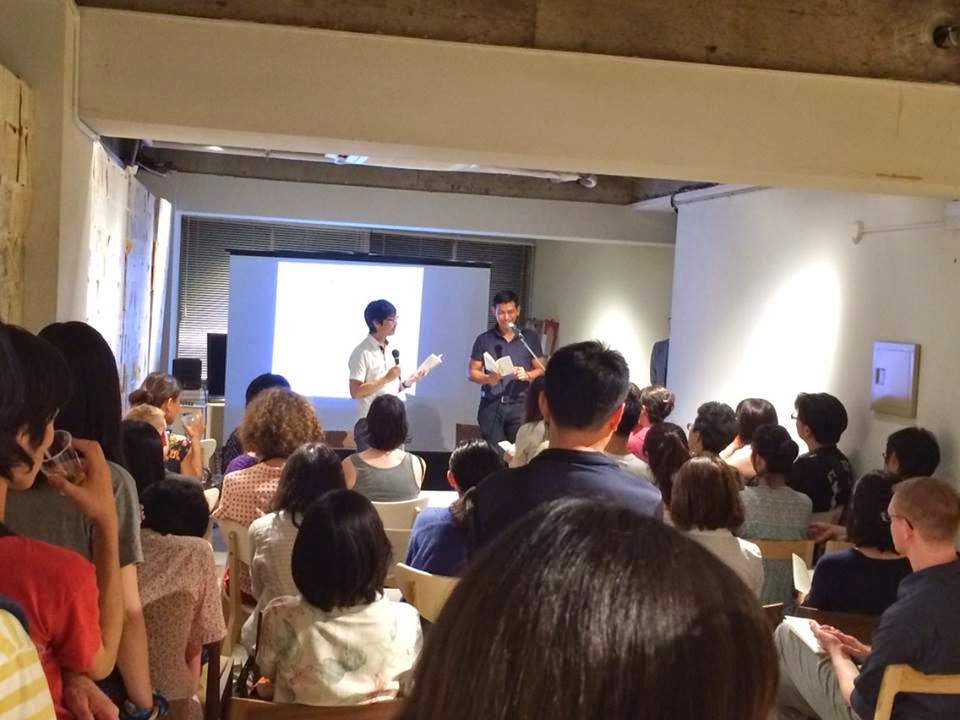
Of all the readings that I've done, yesterday's book launch at Tokyo's Editory stands out for its combination of charm, warmth and sincerity. It was a special delight to meet Mariko Hirasawa, who illustrated my Pillow Book. Mariko, thank you for expressing so well the feelings that you received from the work. You spoke with wonderful animation during the interview. Matthew Chozick, a writer cannot ask for a better publisher. You are always so respectful and enthusiastic. Midori, you touched me when you remembered "Kimiko" from the book, having read the collection three times. Keisuke, I look forward to reading again with you at the launch in Singapore on August 13, and in New York in November. Thank you for introducing me to your loved ones and friends. I am honored to call you my friends. You can purchase the book here .

Osamu Dazai's "Self Portraits"

Translated by Ralph F. McCarthy, Self Portraits: Tales from the life of Japan's great decadent romantic comprises 18 short stories by Osamu Dazai. The long introduction by the translator provides a useful biographical context for the stories. Dazai wrote a form of biographical fiction, which amounted to a light fictionalization of his actual life. The life was certainly decadent. Born into a wealthy and politically influential family, Dazai left his class by marrying a young geisha. He forsook his university education in order to be a writer. He had romantic liaisons with many women. He was addicted to drugs and alcohol. He tried committing double suicides with his lovers, and finally killed himself at the age of 39. The Tales are, however, not romantic with a capital R; they do not seek transcendence of the mundane. Instead, they are wistful, even comical in places, full of consciousness, and self-consciousness, of life's suffering. They are non-resistant to life. "Che...

Departures and NaPo 15

Departures , directed by Yôjirô Takita, is somewhat sentimental, but I could not help but be moved by the home-coming story. Daigo Kobayashi (played by a lovable Masahiro Motoki) gives up a musical career playing the cello and returns to his hometown. There he stumbles into the job of preparing corpses for burial, a work called nokanshi, or "encoffineer." It soon emerges that he is a man wounded by his father's abandonment at the age of six. By sending off the dead in a tender and professional manner, and thus comforting the mourners, he finally achieves consolation for himself. There is a wonderfully comical scene when Daigo has to model as the corpse for a training video featuring his boss and teacher Ikuei Sasaki (Tsutomu Yamazaki). The symbolism of the scene becomes clear gradually as Daigo undergoes a form of rebirth. spring wind walking to work no sweat!

Good Morning, Late Spring

The plot of Late Spring  (1949) reminds me a little of The Golden Bowl . A daughter who loves her widowed father so much that parting, in the form of marriage, is such sweet sorrow. Setsuko Hara plays Noriko Samiya with real inwardness. Having just recovered from an illness during the war, she is seen at the age of 28 to be ripe for marriage. Her father (Chishû Ryû), knowing her attachment to him, and concern for his old age, tricks her into leaving him by pretending to contemplate marriage with a widow. I was thrilled to see Ryōan-ji in the film. The visit to the famous dry garden in Kyoto is the last trip that father and daughter take together, before she leaves the home to be married. Set in suburban Tokyo, Good Morning  (1959) is a humorous satire of postwar consumerism and adult mannerisms. Two boys, brothers, take a vow of silence when their parents refuse to buy them a TV. Their silence comments nicely on the use of small talk as a social lubricant in the adult world....

Learning Japanese

I started learning conversational Japanese yesterday. Met Chisato, recommended by PB, at Panera Bread and looked at basic traveler's phrases. Pronunciation is not difficult. Memorization will take some effort. I've been dipping into Buson's haikus for a month or two now. I do love the warmth and immediacy of his poetry. He makes me want to be a haiku poet. Never had that feeling when reading Basho and Issa. But it's hard to write haiku when the heart is in a state of agitation. Bought Zen Landscape at the New Museum bookstore. Allen S. Weiss writes with genuine feeling about Japanese dry gardens, tea ceremony and ceramics. Wabi-sabi. Mono no aware. An aesthetics of simplicity, asymmetry, use value, old age and the seasons. I'm really looking forward to our trip to Japan in August. I will launch the Japanese translation of The Pillow Book in Tokyo. GH and I are also thinking of visiting Kyoto, and a hot spring town between the two big cities. Chikatetsu wa ...

Haruki Murakami's "Underground"

I'm planning to visit Japan in August and so when I found Haruki Murakami's work of journalism Underground at Kramerbooks in D.C., I bought it immediately, for who can resist a book subtitled "The Tokyo Gas Attack and the Japanese Psyche"? The first, and bigger, part of the book consists of interviews with the victims of the gas attacks, and the family of those who died. These interviews are ordered according to the subway lines on which the Aum attack on March 20, 1995, a Monday, took place. Dissatisfied with the presentation by the Japanese media of a collective image of "the innocent Japanese sufferer," Murakami wanted to discover and document the actual people behind the label of victims, to recognize that each person had, as he puts it, "a face, a life, a family, hopes and fears, contradictions and dilemmas." Most interesting, and moving, are the interviews of the subway staff who had to respond to the emergency. Their interviews are suffus...

Group Portraits

Watched Seven Samurai over two nights, and loved it. One of the imdb reviewers put it best, there are certain directors who just "get" it, who get the medium, and Akira Kurosawa is one of them. I was tired, I was doing what I thought of as a "duty," but I was mesmerized throughout the movie (3 hours, 27 minutes). Total involvement, that must be a criterion of great art, surely. Takashi Shimura, who plays the leader of the band, provides the moral center against which Toshiro Mifune's antic samurai tilts. Isao Kimura is the young untested warrior who falls in love with a farmer's daughter. Less involving but still absorbing is the 1970s cult classic, the break-out novel by Ryū Murakami, Almost Transparent Blue . A group portrait of Japanese hippies (drugs, sex, and rock and roll), it is narrated by a young arts student called Ryū too. The scenes, numbing and addictive, are almost too painful to read, especially the one in which the Japanese had group sex ...

Murasaki Shikibu's "The Tale of Genji"

Reading Genji monogatari i s like dreaming a beautiful and sad dream. The splendor of Genji's person, aptly captured in his nickname the Shining Lord, is marvelous. As is the splendor of his power after his return frome exile at Suma, cosmically represented by his house at Rokujo, with its four quarters and gardens corresponding to the seasons of the year. Yet splendor passes, as Genji first realizes when his father the Emperor dies. The Edo period Japanese cultural scholar Motoori Norinaga first formulated the concept of mono no aware in his criticism of the Tale .  The "pathos of things" reaches its highest pitch in the death of Lady Murasaki, the wife that Genji loved above all. In a moment of reprieve from her illness, Murasaki grieves to imagine Genji's despair when she dies: Alas, not for long will you see what you do now: any breath of wind may spill from a hagi frond the last trembling drop of dew. Genji answers, with unbearable poignancy, When al...

In the Flesh and Tokyo Sonata

Last Thursday we watched In the Flesh (1998), a gay whodunnit directed by Ben Taylor. Ed Corbin plays an undercover cop who falls for a young hustler, a very attractive Dane Ritter. Nothing very original there. Ritter witnesses the murder of his john and becomes a suspect. In the only sex scene of the movie, Ritter fucks a female friend in missionary position. The boys lie naked together in bed, but that's it. Tokyo Sonata (2008), which we watched on Friday, shows the extent to which Japanese men would go to hide their unemployment from their families. Without a job, a man's authority in his home crumbles. Teruyuki Kagawa is convincing as a man who does not know what to do after his social scripts as employee, husband and father are torn up. His blankness is nicely counterbalanced by the suppressed passion of his long-suffering wife, played by Kyôko Koizumi, who attempts escape by driving off with a bungling burglar. The family is finally brought back together by the pian...

Poem: "Marianne Moore in Japan"

Marianne Moore in Japan The weak overcomes its      menace, the strong over-      comes itself. —Marianne Moore, “Nevertheless” I don’t think I would like you very much, Marianne Moore, if we should meet in a beach resort or poetry workshop. It is unladylike, you advised Miss Bishop, to write water closet . She ignored you and now the student is far more popular. She has vulnerability on her side, and the times are partial to helplessness, after wars, pandemics, home foreclosures. What do you have? Another armored animal. See what I mean? How does a reader get close to such glittering finish, how does a lover who will smudge? It’s not sexy to be counting syllables beneath the breath when you can write up ( write it! ) a disaster. Still, I would like to know what you make of the earthquake in Japan, the epicenter at Fukushima prefecture, when shells broke up and we are shown up to be soft through and through. Would you cry with us, castig...

The Pillow Book 31. Hybrid Things

31. Hybrid Things xxx Not only India but Japan. Think, for a moment, of Zen. *