Posts

Showing posts with the label Met

The Body Transformed

Friday night—watched first 3 episodes of the series Atlanta . Good script but uneven acting. GH hated it. The black body as brute and brutalized, as tender and tenderness. Saturday night—Gina Apostol read from INSURRECTO for Second Saturdays. She began a little unsteadily, as I've seen her do at other readings, and then she settled into it and delivered a passionate voicing of the many characters in her novel. The novel restores my faith in the literary form, in its capacity to revisit the atrocities of history and not merely to recount them, but to re-view them. The colonizer is in me just as I am in my colonizer. There is an essential mystery to the large-scale horrors of history, just as there is to final act of the suicide. Sunday—The Met's "Epic Abstraction" show was a big disappointment. After two gigantic rooms of Pollocks and Rothkos, one of this and one of that, in a misguided attempt to show the influence of Abstract Expressionism beyond American shores ...

About Painting

Image
I'm a sucker for movies about writers and artists. Always eager to learn some secret to success, I suppose. As if there is one. Local Color (2006), written and directed by George Gallo, is too simplistic and sentimental to be truly inspirational. The acting by Armin Mueller-Stahl (Nicholi Seroff, the older artist) and Trevor Morgan (John Talia, Jr., the younger artist) makes the film watchable. * I did not know David Hockney started out as an Abstract Expressionist at the Royal Academy. That was probably the greatest revelation of the Met show. In those early works, there was already a keen sense of color. The Room Tarzana (1967) is my favorite of the works on show, beating out all the swimming pools, glass-curtain buildings, Californian landscapes. It has this wonderful sense of coolness about its sexual heat. The most penetrating, psychologically, is "Henry Geldzahler & Christopher Scott" (1969), about the Met curator, ensconced on his throne, and his supplica...

The Plains Indians: Artists of Earth and Sky

Image
Fabulous exhibition at the Met. Beautiful Indian artefacts from pre-contact to present time. Headdresses made from crow and eagle feathers, one feather for every notable victory in battle. Saddle bags, called parfleche envelopes, ornamented with porcupine quills and glass beads. Buffalo skins drawn with stories of war and hunting or with abstract patterns involving the Thunderbird, a guardian spirit. Pipes carved in the form of human effigies. A long courting whistle in the shape of a snipe. Graceful and concise wooden sculptures of buffalos small enough to be held in the hand. Horse masks. A long cherry wood branch transformed miraculously into a snorting galloping horse. A drawing with the silhouettes of more than 80 species of animals, birds and fish that made up the living environment of a people. A winter count chart, on which the the tribal historian drew a picture representing each year, and so provided the storyteller with a mnemonic: the 80th winter shows the lynching of three...

Everything Looks Beautiful

Image
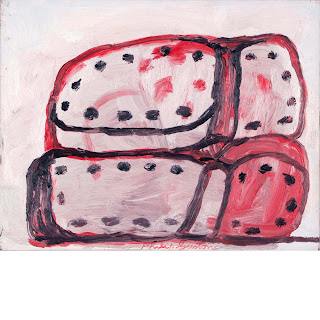
Philip Guston, "Shoes," 1972, oil on panel Life got away from me, and so I've not been able to blog it down. So here's catch-up. March 15 evening: GH and I attended a Singapore get-together at P and A's home. I was expecting an informal potluck event, but that showed how out of touch I am with my Singapore friends. A is Singapore's ambassdaor to the UN, and so lived in appropriately well-appointed circumstances. A man took our jackets, another tended to the bar. Yet another took away our dishes after we were done feasting on the buffet dinner. Fortunately P and A were a very down-to-earth couple. Unlike some of the suits there, A was wearing just shirtsleeves. They soon made us feel welcomed. I had not seen P for years, and was pleased to see that she has not changed in appearance or manners, at least not at first re-acquaintance. I met a woman who works for one of the UN bodies, and her husband who teaches management studies at Columbia. There was...

Matisse: In Search of True Painting

Image
I have not seen the show yet, but bought the beautifully produced catalogue at the Met. All the essays examine the show's focus: Matisse's work in pairs, trios or series. Landscapes, still life, interiors, nudes--these genres at the heart of Matisse's painting--saw intense experimentation in the re-working of an original. What is striking about Matisse's pairs is that they were very often painted in the same format and size. These were very controlled experiments. More radically, they were also shown by Matisse as finished paintings in their own right. The sketch was traditionally hidden from sight but not Matisse's. Later in his career, he showed, together with the painting, the photographs that documented the progress of the painting. He was responding to the charge of easy conservatism. He insisted that he was a painstaking artist who was constantly pushing the boundaries of his art. Of Interior in Yellow and Blue (1946) and Interior in Venetian Red (1946...

Poetry-Art-Art-Poetry

Christopher Ricks gave a brilliant reading of Hardy's poem "Wives in the Sere" at the ALSCW-sponsored panel at Poets House on Friday. He defended Hardy's rhymes from the criticism of John Crowe Ransom and showed how the two atypical rhymes in the poem "unknows" and "muser" carry the burden of significance. After the talk, EN and I walked from Battery Park City to the West Village and had dinner at the Irish pub Dublin. S and R came to stay with us last night. In the afternoon they went by themselves to the Cloisters. Then we went with them to the Met, to the rooftop to see Cloud City, and the real city sparkling in the blue night. We whizzed through the Andy Warhol show. I looked only at his works and not at the work of his imitators and followers. I was resistant at the beginning, but at the end his work was so clearly superior to others around it. A consistent insoucience that dared to laugh at all the pretensions of serious art, its power was ...

"Schiaparelli and Prada: Impossible Conversations"

Really enjoyed the Schiaparelli and Prada show "Impossible Conversations" at the Met yesterday. Civilized, subversive, intelligent. I liked it much more than the over-the-top spectacle of last year's Alexander McQueen. The Met's Spring 2012 Costume Institute exhibition, Schiaparelli and Prada: Impossible Conversations , explores the striking affinities between Elsa Schiaparelli and Miuccia Prada, two Italian designers from different eras. Inspired by Miguel Covarrubias's "Impossible Interviews" for Vanity Fair in the 1930s, the exhibition features orchestrated conversations between these iconic women to suggest new readings of their most innovative work. Iconic ensembles are presented with videos of simulated conversations between Schiaparelli and Prada directed by Baz Luhrmann, focusing on how both women explore similar themes in their work through very different approaches. The show was divided into seven themes: "Waist Up/Waist Down," ...

Exit Strategies

Music and words. Hard not to make one subservient to the other. Exit Strategies , the May 2 event organized jointly by PEN World Voices and the Met Museum, avoided the issue by and large by having music and words work separately, and so the chief interest of the evening for me lay in their dissonance. GH was less amused. The music was provided by the Kronos Quartet with a long history of in-depth collaboration with composers like Terry Riley, Philip Glass and Steve Reich, and with musicians like Chinese pipa virtuoso Wu Man, Bollywoord "playback singer" Asha Bhosle, Inuit throat singer Tanya Tagaq, Mexican rockers Cafe Tacuba and Azeri vocalist Alim Qasimov. During the event, the quartet played imperturbably a wide range of music from around the world. The same could not be said of the writers who clearly felt that their words were intruding on the music. Rula Jebreal, a French-Israeli journalist, asked her American audience a series of questions about the state of politi...

Poem: "The Death Mask of Lorenzo de' Medici"

"The Renaissance Portrait from Donatello to Bellini" at the Met is a fabulous show of paintings, sculpture, drawings and commemorative coins. It begins with artwork commissioned and executed in Florence, the center of the early Italian Renaissance, before moving to the courts of Milan, Bologna, Ferrara and Naples, ending finally with another burst of splendor in Venice.  If the profile portraits at the beginning of the show obeyed Leonardo da Vinci's advice to look for three important points of a face--forehead, nose and chin--the portraits at the end of the show examined the human face from many more angles. Along the way the Dutch influence is introduced by way of Memling and other Low Countries artists, to create a more psychologically acute and intimate style. Almost all the people portrayed belonged to the wealthy or noble families of Italy. There are a few ecclesiastical portraits, including the unexpectedly voluptuous "Fra Teodoro of Urbino as Saint Dominic...

Xie Zhiliu (1910-1997) at the Met

Image
The title of the exhibition says it all: Mastering the Art of Chinese Painting. Unlike many Chinese artists, Xie Zhiliu, a native of Changzhou, kept the copies and sketches he made throughout his career, and these now provide an absorbing account of the development of a traditional Chinese painter working in the twentieth century. Copying the masters and working from nature were the complementary disciplines of such an education. Not knowing the tradition in which he worked, I found it hard to distinguish between Xie's work and the work of his chosen masters, like the Ming painter Chen Hongshu (1599-1652) and other bird-and-flower painters. I could see that his lines, as a young painter in his twenties, were less sure than theirs, but I could not see how he departed from them deliberately. Even the drawings done from nature looked as if they had been traced. I was most impressed by the work in the last gallery. (I could not find any images of the work on the Met website.) T...

The Lion, the Werewolf and the Harlequin

Image
I was expecting theatrical magic from The Lion King , when I watched it with my family on July 4. The show was engaging, but proved to be less than enchanting. When I watched the parade of puppet-animals on YouTube, accompanied by the song "The Circle of Life," I cried. At the Minskoff Theatre, the song sounded tinny, and the puppets by Julie Taymor, beautiful individually, were too few to really impress. Only one elephant? One rhinoceros? Everything seemed smaller than the YouTube video had led me to imagine. The less heralded stage design, by Richard Hudson, was for me much more impressive. Pride Rock rose in a majestic spiral from the stage floor. In contrast, Scar's cave was a slanted bed of rock limited by a triangular ceiling. The staging of the wildebeest stampede, during which Mufasa fell to his death, was wonderfully imaginative. The singing, by the ensemble as well as by Dashaun Young (Simba) and Chauntee Schuler (Nala), did not do justice to the Elton John ...

"Henri Cartier-Bresson: The Impassioned Eye" (2003)

JS, EN and I braved the snow last evening to see Robert Frank at the Met. It was strange: I did not like the show of photographs as much as the first time. Many of the photos were really not very interesting, and seemed to be there in "The Americans" for the sake of theme than for their individual aesthetic power. JS said that he has seen many images at Flikr as good as the ones in the show. I guess Frank should get some credit for doing it first. Perhaps I have been influenced by the documentary on Henri Cartier-Bresson called "The Impassioned Eye" (2003). The photos of the French Master wielded great power, as a result of what he called the alignment of the eye, mind and heart. Some photos were more concerned with geometric form, others with emotional mystery, but they were all individually beautiful. I love the images of old Matisse with his birds. History was captured at the liberation of Paris, the death of Gandhi and the Communist takeover of China. This was ...

Looking In: Robert Frank's "The Americans"

The Met exhibition features all 83 of the photographs in Frank's "The Americans," made on a cross-country roadtrip in 1955-56. The experience of seeing the photographs on the wall was very different from that of viewing the images in a book. Looking at the photos so carefully sequenced by Frank, I was led in a linear fashion from room to room, and so experienced in a small way the journey he undertook to record the common joys and sorrows of Americans. At the end of the roadtrip, I had the sensation of experiencing an epic. Each section of his book, and of the exhibit, begins with a photograph of the American flag. The flag hides the faces of two women looking out of a tenement. It declares its patriotism from the top of a bar, between Washington and Lincoln. Translucent and bright, it descends from nowhere, like a spirit, onto a family picnic. The photographs are juxtaposed to bring out subtle connections and contrasts. Detroit workers on a hellish assembly l...

Francis Bacon at the Met

I saw again last night the huge Bacon retrospective at the Met. I had been dreading a second look because I had read some less than worshipful reviews in the meantime, and I wondered how they would affect another encounter with the works. I am glad to report that my worship has cooled down, not to disappointment, but to a strong admiration for the painter. It has become reasonable. It is not easy to be reasonable with Bacon, because his paintings elicit--strive to elicit, in fact--visceral reactions. That contorted, broken body on the divan: if you don't submerge your eyes in its pain, you will only see the ridiculous melodrama--the faulty epistemology--of paint imitating blood and semen. It's no longer a surprise to see modern works splattered with blood and semen--and shit--but Bacon is more painterly than that. The effect must be achieved through paint. That intransigency is a strength. No collages for him, no "real-world" objects. He relies on photographs but uses...

Narrowing the Eyes

Met JMS and RDM at the Cloisters yesterday, my third visit to the Met's medieval collection. If I feel heroic and imperial in the Classical sculpture court in the Met main building, I always feel monkish and stooped as I pace round the four cloisters here. The religious iconography is oppressive, only occasionally relieved by unexpected figures of monkeys, cocks, and unicorns.  The Merode altarpiece, despite its large significance for Western painting, as explained by JMS, is a cramped and cramping allegory. So, the mousetrap--worked on by Joseph--represents Christ, God's bait for the devil (a metaphor from Augustine), the lilies represent the Virgin's purity, the sixteen sides of the table represent the sixteen major prophets of the Bible, so on and on. But I am no longer moved by such dry correspondences. The smallness of the books, of the ivory and wood carvings, adds to my feeling of a dark, confined space. The detail is spectacular, and the line, as in a tiny torso of ...

Cast in Bronze and Brooklyn

Having an unexpected hour to spare, before the Chin Music reading, I walked over to the Met, and wandered into the exhibition "Cast in Bronze: French Sculpture from Renaissance to Revolution." My instinct is to prefer marble to bronze as sculptural material. Marble is as pure as bronze is fussy. Stone, to my mind, is more organic than tin. Marble is to sculptor as metal is to engineer. Bronze, an alloy of tin and copper, was expensive during the period under consideration, and so brass was a frequent substitute. Many of the works were made using the "lose-wax" method. Different patinations were used, but a rich dark patina came to be preferred later in the French tradition.  I like very much a bronze statuette of Hermes by Barthelemy Prieur (Berzieux, ca. 1536-Paris, 1611). The head, body and arms are tilted in opposing yet harmonious directions, as the god plays his missing flute. The French excelled in dramatic set pieces and seemed particularly enthralled by rape...

Bonnard's Late Interiors at Met Museum

The exhibition tries to put the case for Bonnard as a modernist master, and not a mere Post-Impressionist working past the due date of the movement. Restricting the show to his late interiors, however, does not help to make the case. The color experiments look interesting, but not innovative; his pictorial language changed little in these paintings from 1927 to the end of his life in 1947.  He painted the dining room, the breakfast room, the upstairs bedroom in his house at La Cannet, and the objects in them like a raffia basket of fruits, a vase of flowers, bottles of wine. The one still life that really held my attention was that of a bowl of cherries. And "The Breakfast Room" is noble. But I remember being bowled over by his paintings of the terrace and garden seen elsewhere. At this show I was underwhelmed.  I don't understand why one critic called Bonnard "the most abstract of painters." These late interiors seem to me insufficiently abstract. They are conc...

From Raphael to Renoir

Image
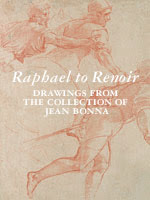
150 drawings from the collection of Swiss Jean Bonna are on display at the Met . Drawn from a variety of artistic schools in Italy, Northern Europe, France and Great Britain, they map a traditional art history chronology--Italian Renaissance, Dutch and Flemish Mannerism, French Rococo, classicism and Impressionism, British Decadence.  Among the earlier pieces, the head portraits were most interesting to me. Head of a man wearing a turban. Head of a young girl. Though these were preparatory sketches for oil paintings, they are drawn with delicacy and feeling. In red, black and white chalk. In brown ink and wash. I wish they had put up a picture of the oil painting next to its preparatory sketch, for the sake of comparison, but I guess that would have reduced the space for the drawings themselves. Not all the drawings on exhibit were preparatory sketches; some were drawn for sale after a painting gained a following. Among the Italians, I was most taken by the drawings of Andrea del Sarto...

Wang Hui at the Met

This exhibition is the first time the Met focuses on a single Chinese painter, here, the virtuosic 17th century landscape painter, Wang Hui (1632-1717). It is a great opportunity to study the artistic evolution of a significant Chinese painter. The first three galleries display the Tang, Song and Yuan styles of painting that inspired Wang Hui. The rest of the galleries are devoted to his works, gathered here from the Taipei and Beijing Palace Museums, the Shanghai Museum, North American collections, as well as the Met's permanent collection. Roberta Smith, in The New York Times, reviews the exhibition in glowing, if somewhat uncritical, terms. Along the way she takes swipes at excessive laments about the harmful effects of the art market, and at rigid distinctions between creating a personal style, and copying the Old Masters. The art market is not a modern, let alone contemporary, phenomenon. Wang Hui, by synthesizing the styles of mentors and Old Masters, does create an individ...

How to Read Chinese Paintings

Image
In this exhibition , the curatorial explanations and enlarged photographic details illuminated many fine points of style, influence and history. What intrigued me was the manner in which the viewer of the work of art responded to it. As Maxwell K. Hearn explains in the introductory essay of the catalogue: Integrating calligraphy, poetry, and painting, scholar-artists for the first time combined the "three perfections" in a single work. . . . In such paintings, poetic and pictorial imagery and energized calligraphic lines work in tandem to express the mind and emotions of the artist. . . . Once poetic inscriptions had become an integral part of a composition, the recipient of the painting or a later appreciator would often add an inscription as his own "response." Thus, a painting was not finalized when an artist set down his brush, but it would continue to evolve as later owners and admirers appended their own inscriptions or seals. Most such inscriptions take the f...