Posts

Showing posts with the label Picasso

Diary and Haiku

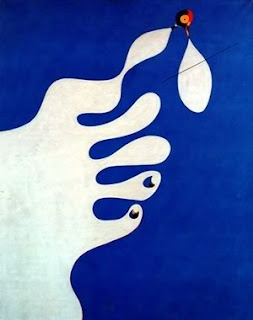
After looking at Guernica , the crowd at my elbows, their tour guide in my ears, I am coming out against history painting. The magniloquence of terror. The demand for submission. Far more delightful is the magic of Joan Miró, whose rooster crows in a landscape with it in it. On the balcony carrying a bowl of cereal cock-a-doodle-do

Monstrosity is the Untruth

TLS October 25 2013 from Jack Flam's review of T. J. Clark's Picasso and Truth: From Cubism to Guernica : Although Clark takes a rather long and circuitous route to conclude that Picasso is a monist whose art is amoral--not from indifference, but from a reality principle (the world itself being amoral)--his discussion of parallels between Nietzsche and Picasso contributes to a better understanding of Picasso's uniqueness as a thinker as well as a painter. It also provides an implicit rebuke to Jung's expectation that great art be "good" as well as beautiful. Following Nietzsche, Clark maintains that the way monstrosity collapses normal terms of identity and difference can be a substitute for truth: "Monstrosity is the Untruth--the strangeness and extremity--inherent in everyday life".

Nice, August 17 - 24

Image
The train ride from Paris to Nice took more than the promised four-and-a-half hours. The country views were brilliant--open blue skies, ochre rolling fields--and seeing the Mediterranean for the first time as the train hugged the coastline was very special, but next time we will take a plane instead. We left the crowded train station, picked up our apartment keys from a hotel nearby, and walked through the city, rolling our bags behind us. We were struck by how Italian the city looked. The first settlement was founded by the Greeks of Marseilles around 360 BCE. It came under the dominion of Savoy, then France, then Piedmont-Sardinia, and then back to France in 1860. After we had settled into the apartment on Rue de Suede, we took a walk along the famous Bay of Angels, by the Mediterranean. Nice, Bay of Angels The next day, the plan was to hit Coco Beach, some way out of the city, but we found an outdoors market when we walked about Vieille Ville, or Old Town. The Sunday market ...

Three weeks in Singapore, June 27 to July 17.

Image
1 Visit to Gardens by the Bay. I took parents to the Flower Dome and Cloud Forest. We were rather underwhelmed, I think. Much more enjoyable was our visit to the Botanic Gardens, where a Talipot Palm in its 80 th year was flowering for the one and only time before it died. 2 Parties. Pink Dot party at Park Royal Hotel, and a party at KA’s lovely home in Tiong Bahru. Met CCYC for the first time at Pink Dot. She took me to a party in Park Royal Hotel, one of many gay parties that night that overlooked the mass gathering. The host N knows CW from university days when they sang in the same choral group. Met there a number of young Singaporean artists, and a curator DC from the Singapore Arts Museum, who just returned from the Venice Biennale. He was trained in Goldsmith, in London. Met a cute couple there, H who is Malay and a civil servant, and V who is Chinese and an architect. Also was introduced to KA, who heads Heritage Conservation at the URA. It was a queer arty ci...

Poem: "Mira, Miro"

Image
Borrowed from the library of Instituto Cervantes the MoMA catalogue of its 1993 Miró show. The catalogue essay Peinture-Poésie, Its Logic and Logistics by the show curator Carolyn Lanchner gives an interesting overview of Miró's oeuvre. What Picasso said to the young Spanish pretender became the opening of a new poem. I quoted, and, in a few cases, modified, titles of Miró's paintings for the rest of the poem. Miró loved poetry, and gave his paintings poetic titles. To my mind, it is somehow apt to incorporate and orchestrate his painting titles into a poem. Mira, Miro La Guitarra advised the Catalan peasant, pretend you’re waiting for the subway; you have to get in line. Wait your turn, after all. Painting. A bird eyes the hunter in a pinkish Catalan landscape. Person throws a stone at a bird. Painting. Hand catching a bird. A white bird floats above the carnival of harlequins. Painting. A yellow bird orchestrates a Dutch interior (I). (II)....

Inventing Abstraction: 1910-1925

Image
Fernand Léger, "The Discs" 1919 The MoMA show is huge. Picasso and Kandinsky open it but it quickly expands to look at the network of artists all across Europe--including America--producing abstract art. The show is organized mostly according to countries: Russia, France, Germany, Italy, England, the USA. Artists who moved to work in a foreign country are grouped with their colleagues, so the two works by Marcel Duchamp are placed with the work of Stieglitz and other Americans. I love his painting "Movement from Virgin to Bride," which counters Kandinsky's valorization of the spiritual in art with Duchamp's preference for the sensual. It was a treat to see works by Duncan Grant and Vanessa Bell representing England. Gino Severini is also a stand-out for me. There is a wonderfully frilly painting by Giacometti, so sensationally different from his sculptures. Best of all is the work of Fernard Léger on display. It is rhythmically vital and yet reassuring...

Picasso Black and White

Image
"Picasso Black and White," now on at the Guggenheim, is worth every cent of the $22 entrance fee, and more. The exhibition showed the Spanish master deploying the stark colors in every phase of his career. And he did so not only in his nudes, but also in his still-lifes and political works, most famously in "Guernica," represented in the show by two harrowing studies made for the final painting.. By stripping his paintings of color, he wished to display more clearly the anatomy and structure of his work. This concern for volume answered a question I always had about his investigations into Cubism. For a painter who was so sensuous in his apprehension of the world, Cubism seemed overly analytical and angular. The apparent contradiction is resolved, for me, in the understanding that Picasso's sensuousness is a matter of the handling of volumes, not of fingers running over surfaces, and even less of eyes drinking in the hues of objects. The range of ways in ...

What to do in and around NYC

The last three weekends were busy ones. S and R drove up from D.C. to stay with us overnight on September 29. We went up to the roof of the Met and enjoyed the glittering autumnal view there. Then we had a very nice dinner at le Paris , which I strongly recommend. Columbus Day weekend began on Friday with drinks with DW. We hadn't seen each other for a long time, and the time at Suite Bar passed very pleasantly, so pleasantly that we both wondered afterwards why we were not meeting more often. Then on Saturday, dinner with P and J at Spring Natural Kitchen on the UWS because J wanted to try its organic cooking. Dinner was a success. It was so easy to be with them, so relaxing.  On Sunday G and I went to Philly for the day. We both loved the new Barnes Foundation building, designed by Tod Williams. I was mesmerized by the Matisse dance mural but liked "The Joy of Life" much less than I thought I would. I had the unwanted feeling that the Picasso works in the coll...

Fascist Art

Most art shows stroke the museum-goer to a climax. Chaos & Classicism , at the Guggenheim, ends differently. Not in an anti-climax, but rather in a depressing one. After displaying beautiful classicizing works by the likes of Dix, Picasso, Balthus and Léger, the show leaves the rotunda and enters a room titled "The Dark Side of Classicism."  It is filled with paintings, murals and sculpture inspired by Fascism, depicting muscular warriors and heroic horsemen. At the end of the room plays the film of the 1936 Berlin Olympic Games, in which the Discus Thrower comes alive as a German triathlete. The art is bad, but therein lies my dissatisfaction with an otherwise enlightening show. The equation of bad art and bad idea is too easy. It would have been far more interesting, far more complicating, to show beautiful art done by bona fide Fascists. Do such works exist? Can they? Also saw two small sculptures by Spanish sculptor Pablo Gargallo, who appears in Marianne Moore...

The Lion, the Werewolf and the Harlequin

Image
I was expecting theatrical magic from The Lion King , when I watched it with my family on July 4. The show was engaging, but proved to be less than enchanting. When I watched the parade of puppet-animals on YouTube, accompanied by the song "The Circle of Life," I cried. At the Minskoff Theatre, the song sounded tinny, and the puppets by Julie Taymor, beautiful individually, were too few to really impress. Only one elephant? One rhinoceros? Everything seemed smaller than the YouTube video had led me to imagine. The less heralded stage design, by Richard Hudson, was for me much more impressive. Pride Rock rose in a majestic spiral from the stage floor. In contrast, Scar's cave was a slanted bed of rock limited by a triangular ceiling. The staging of the wildebeest stampede, during which Mufasa fell to his death, was wonderfully imaginative. The singing, by the ensemble as well as by Dashaun Young (Simba) and Chauntee Schuler (Nala), did not do justice to the Elton John ...

Reinforced Concrete or Platonic Realm

TLS June 5 2009 from Tom Holland's review of Theodore Ziolkowski's Minos and the Moderns , and Cathy Gere's Knossos and the Prophets of Modernism : Far more than the narratives associated with other legendary captials--Troy, Mycenae, Thebes--"the matter of Knossos" came with comparatively little baggage attached. No wonder, then, that throughout the twentieth-century, this combination of a clean cultural sheet with an undoubtedly archaic resonance should have inspired so many writers and artists to jump onto the Minoan bandwagon. * Many of the novels, poems and paintings that [Ziolkowski] describes in his book were veritable mazes of symbolism. So potentially resonant is a figure like the Minotaur, for instance, and yet so lacking in culturally sanctioned signification, that it seems that he can be made to stand for almost anything. Indeed, perhaps it is precisely the ability to play Theseus, to pin the monster down, to defy the tendency of the Cretan myth to over...

"Mosqueteros": Picasso's late works

The human figure, his own and others', preoccupied Picasso to the end of his life. "Mosqueteros," an exhibition at Gagosian of his late paintings, curated by his biographer John Richardson, is violent and heroic. The painter, here in various guises, is a musketeer, a matador, and a clown. The women are giantesses. One of my favorites in this exhibition is "Femme" 1972, a mountain of a woman who dominates what looks like a park. The sex in many paintings are explicit, the figures not so much coupling (with the connotation of freight cars) as grappling, the cubist angles further contorting bodies and movements. Often, the man in these scenes pushes his face into the woman's face, as if to seize her by his eyes alone. In "Etreinte" 1972, the penis may look unimpressive, but not the huge straining arms and legs, against a backdrop of cheerful blue waves. He grapples not only with humans, but also with superhumans. The self-portraits strive to outdo mas...

Paris Diary

Image
July 23, Wed 1332 Eurostar from St. Pancras to Gare du Nord. Apartment in gated community, on Rue Lamerciere, in Pigalle. Had dinner at Chartier, on Faubourg Montmartre, popular low-priced eaterie, with Belle-Epoque decor, the set for many movies. Drank at Raidd Bar, where, at midnight, the go-go boy showered in a glass stall set in the wall. I think I can live in Paris every summer. The light is beautiful here. July 24, Thu Breakfast at Point Bar, larg expresso and croissant. Finished reading Kim . Visited Musee National Picasso: Sleeping Woman, The Kiss, The Swimmer, Child Playing with Truck. The Goat. Impressed by the range of his experimentation with modes, materials and methods, while remaining inspired by the human figure. Striking series of photos of the artist taken by people like Man Ray and Cartier-Bresson. The photos show how much he resembled his female heads physically. Visited Nortre Dame while as mass was going on. Sat in the Jardin du Luxembourg for a while, enjoying th...

London Diary

July 13, Sun Arrived late at Parliament View Apartments, along Albert Embarkment. Danced at Fire, in Vauxhall. July 14, Mon Walked round Westminster and Soho. Watched Billy Eliot the Musical at Victoria Palace Theatre. Drank at Comptons.  July 15, Tue Spent afternoon with Anna and James at Hyde Park. Had dinner with Mary and Derek in Soho. Drank at Comptons and G-A-Y.  July 16, Wed Walked along South Bank. Visited Tate Modern: Bacon and Picasso room; Pollock's Summertime . Watched stand-up comedy at Royal Vauxhall Tavern. Drank at Barcode Vauxhall. July 17, Thu Watched King Lear at Shakespeare's Globe. Dinner at the Box. Drank at Rupert Street and 79 CXR.  July 18, Fri Visited the British Museum: the Parthenon Marbles. Danced at G-A-Y.  July 19, Sat Visited Sir John Soanes Museum: Hogarth's Election and The Rake's Progress . Visited National Gallery: Cezanne's Bathers (Les Grandes Baigneuses);  Seurat's Bathers at Asnieres;  and Velazquez's The Rokeby Ve...

Bathers at MOMA

Image
Paul Cézanne. (French, 1839-1906). The Bather. c. 1885. Oil on canvas, 50 x 38 1/8" (127 x 96.8 cm). Lillie P. Bliss Collection Henri Matisse. (French, 1869-1954). Bather. Cavalière, summer 1909. Oil on canvas, 36 1/2 x 29 1/8" (92.7 x 74 cm). Gift of Abby Aldrich Rockefeller. © 2008 Succession H. Matisse, Paris / Artists Rights Society (ARS), New York Pablo Picasso. (Spanish, 1881-1973). Bather. winter 1908-09. Oil on canvas, 51 1/8 x 38 1/8" (129.8 x 96.8 cm). Louise Reinhardt Smith Bequest. © 2008 Estate of Pablo Picasso / Artists Rights Society (ARS), New York The Cezanne bather is a statue, the Matisse a bear, the Picasso a dancer.

TLS, August 17, 2007

from Peter Holland's review of William Shakespeare: the Complete Works , edited by Jonathan Bate and Eric Rasmussen: On King Lear--"The coronet, the commentary assures us, "must be of material that can be broken in half", but this is to read Lear's instruction to "part" it too literally, to assume that the speech and a stage-event are aligned. The exhilarating theatrical point may be precisely that the coronet cannot be divided, that, try as they might, neither Lear nor his sons-in-law can split the metal ring, that the circle, such a potent sign of wholeness, will not break--especially in a play fascinated by the way "The wheel is come full circle", as the dying Edmund puts it. *** from Barbara Everett's Commentary piece on biographies of Shakespeare, "Reade him, therefore": In an important sense Shakespeare did not live in his life, if by life we mean circumstantial existence. Neither a dreamy aesthete nor a dithering incompete...
Image
"From El Greco to Picasso," the Spanish art exhibition at the Guggenheim, was organized according to subjects: religious portraits, still life (or bodegón, ‘things from the pantry”), landscapes, childhood, secular portraits. This thematic organization facilitated the comparison of different artistic approaches and the tracing of artistic influence. It became strikingly clear, for example, how much Picasso owed to his Spanish predecessors, notably Goya in the still life paintings, for his subjects, his vision and his innovation. I particularly liked “Still Life with Cardoon and Parsnips,” painted in 1604 by Juan Sanchez Cotan (1560-1621). The cardoon was painted with such close attention to detail. The fibrous threads along each segment of the vegetable were short spikes nearer the base, hairs further along the segment, and then feathers near the tip. The segments were delicately ridged, their mottled texture conveyed by the brushstrokes. The curve of the cardoon was continued...

Cezanne to Picasso: Ambroise Vollard, patron of the avant-garde

Image
Patrick McCaughey, in his TLS review, inveighed against the Met for enshrining in an exhibition an art dealer who was, in McCaughey’s words, “the reverse of the patron: he was the exploiter of the avant-garde.” When I saw the exhibition yesterday, I read in at least two curator’s notes that Vollard sold the paintings for ten times the meager sum he had paid the artists. The notes made me wonder if the exhibition’s title was not intended as somewhat ironic. Such titles, emblazoned on a huge banner in front of the Met, are not usually ironic but this one might serve the dual purpose of promotion and criticism. I thought the exhibition highlighted the exchange of monies behind these familiar masterpieces. Looking at Cezanne’s “A Basket of Apples,” I was struck by how all the apples had different shapes and colors. Each apple was also presented differently from the others: one showed more stalk; one more tilted; one half-wrapped by the cloth; one almost hidden by the basket. The effect is ...

Hopper, Picasso and the Americans at the Whitney

The Whitney devotes the entire fifth floor to Hopper’s paintings and drawings, as a part of its “Full House” anniversary exhibition. The first room looks at Hopper’s Paris apprenticeship. In choosing river and bridges for his subjects, Hopper was clearly influenced by the Impressionists’ emphasis on outdoor light. The paintings, however, do not display the textured brushstrokes that aim to capture the phenomenology of light; they consist of regular shapes colored in with brushstrokes that efface themselves. Hopper’s preoccupation with light is seen in the titles of some of his more famous paintings. “South Carolina Morning” depicts a black woman dressed sexily in red, standing in a doorway, and looking out at bright fields and sky. In “Cape Cod Evening,” an elderly couple, in front of their house, watches their dog play in their long-grass lawn. The grass is light golden, echoed and enriched in the golden brown fur of the dog. Next to, and behind the house, stand dark blue trees. Lig...